


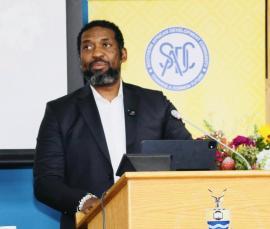
Higher Education and Training Minister Buti Manamela has warned that Southern Africa cannot achieve meaningful industrialisation if it continues exporting raw materials, while importing the knowledge, technology and finished products that capture the greatest value.
Speaking at the SADC Vice Chancellors’ Meeting at Wits Business School in Johannesburg on Monday, Manamela said universities across the Southern African Development Community (SADC) have a critical role to play in building the knowledge and human capabilities required to drive regional industrialisation, innovation and economic transformation.
“A region cannot industrialise on borrowed knowledge,” Manamela said, warning that SADC countries risked remaining consumers of technologies and knowledge developed elsewhere while exporting raw materials.
He said the industrialisation agenda adopted by SADC Heads of State and Government requires the region to strengthen its own capacity in engineering, science, technology, research and innovation.
“Human capability is part of that infrastructure.”
Manamela said infrastructure such as roads, railways, ports, energy systems and digital networks do not design or transform themselves, but require engineers, scientists, technicians, academics, entrepreneurs, health professionals, teachers, public servants and artisans.
“They require institutions capable not only of transmitting knowledge, but of producing the knowledge that allows the region to make its own choices. Universities are therefore not observers of regional integration. They are part of its infrastructure,” Manamela said.
The Minister said regional integration remains incomplete while students, academics and qualifications continue to face barriers when crossing borders.
He pointed to challenges around credit transfers, recognition of qualifications, researcher mobility and the ability of employers to compare qualifications and skills across SADC countries.
“Our systems of learning remain more fragmented than the lives they are meant to serve.,” the Minister said.
Manamela stressed that the SADC Protocol on Education and Training, including the SADC Qualifications Framework, and the proposed Higher Education Strategy are important foundations. However, he said a framework that cannot change the experience of a student, scholar or employer remains an aspiration.
He said the strategy must identify areas where SADC countries can build capabilities collectively, avoid unnecessary duplication between institutions, and align research with regional industrial value chains.
“By the time SADC Ministers responsible for Education and Training, Science, Technology and Innovation meet in South Africa in June 2027, we should report more than completed documents. We should point to programmes begun, students and academics who have moved, data being shared and research missions producing results,” Manamela said.
University of transformation
Manamela also supported the proposed SADC University of Transformation but said it does not need to become another conventional university with headquarters, a new bureaucracy and programmes that duplicate existing institutions.
“The University of Transformation should be a network of regional capability. It should connect universities, Centres of Excellence, TVET institutions, research councils, industry and development partners through shared doctoral schools, research chairs, digital programmes, laboratories, mobility and workplace learning.
“A student could be registered at one institution, access specialist teaching through another, use shared cyberinfrastructure, participate in a regional research project and undertake an industry placement elsewhere in SADC. That is a more intelligent use of regional strength,” the Minister said.
The Minister added that the university credibility will depend on a clear mandate, sound governance, academic quality, sustainable financing and visible early programmes.
A key focus should be critical-minerals beneficiation, food and water security, climate resilience, energy transition, public health, digital capability and infrastructure, he said.
Manamela also called for greater investment in regional computing capability, trusted datasets, African-language technologies, cybersecurity, scientific infrastructure and intellectual property as artificial intelligence reshapes economies.
“If our universities do not build regional computing capability, trusted datasets, African-language technologies, cybersecurity, scientific infrastructure and intellectual property, we will rent intelligence from others while surrendering value created from our own societies. This is not an argument for isolation [but] an argument for the capacity to participate in the world on more equal terms,” Manamela said.
Manamela also called for an increased participation of women in science, engineering and technology, saying the region cannot not afford to exclude half of its intellectual potential.
He identified five immediate priorities for the meeting, including agreeing on implementation priorities for the SADC Higher Education Strategy; establishing a network model for the University of Transformation; improving qualifications recognition, credit transfers and academic mobility; agreeing on a regional higher education data system; and launching flagship research and skills programmes linked to SADC’s industrialisation priorities. – SAnews.gov.za


