


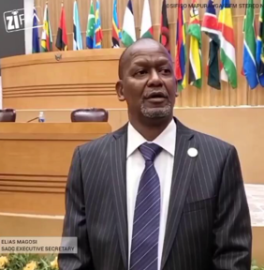
Southern African Development Community (SADC) Executive Secretary Elias Magosi has highlighted progress made by the region in energy, digital connectivity, trade, investment and agriculture, while calling for deeper regional cooperation to address persistent challenges facing Member States.
Magosi was speaking on Wednesday at the official opening of the Ordinary Meeting of the SADC Council of Ministers in Durban.
He said the region was meeting against the backdrop of profound global change, including geopolitical tensions, shifting economic realities, declining development assistance and conflicts in various parts of the world.
“While these developments pose challenges for the region, they also reinforce an important lesson we can no longer ignore, that the future of our region will increasingly depend on our ability to trust each other more and work together more, to strengthen regional resilience and drive our own development agenda under our own terms,” Magosi said.
He said this understanding informed the Retreat of SADC Ministers of Foreign Affairs held in Skukuza, Mpumalanga, in May, where Member States reaffirmed their commitment to deeper regional integration, collective resilience and sustainable development.
Energy and digital connectivity
Magosi said the SADC region added 3 253 megawatts of new installed generation capacity across 12 mainland Member States during the 2025/26 financial year, with a further 1 611 megawatts added by the Island States.
The region's total installed capacity now stands at 88 202 megawatts, while operational capacity has reached 54 812 megawatts, exceeding combined regional peak demand and reserve requirements of 52 617 megawatts.
However, Mogisi stressed that progress in the energy sector should ultimately be measured by the number of households, schools, health facilities and businesses gaining access to reliable electricity.
Regional electricity access increased from 56% in 2024 to 60% in 2025, although this remains below the target of 85% access by 2030.
Magosi called for accelerated grid expansion, stronger cross-border interconnections and increased investment in off-grid and renewable energy solutions.
On digital connectivity, he said internet penetration had risen to 57.2%, while 4G network coverage reached 79.2% and mobile penetration stood at 95.2%.
“These achievements are helping us to drive innovation, improve connectivity and expand economic opportunities across the region,” he said.
Trade, investment and industrialisation
Magosi said economic transformation remained at the centre of SADC's regional integration agenda, although performance across key economic indicators remained mixed.
Manufacturing Value Added (MVA) as a share of GDP declined from 11.3% in 2024 to 10.9% in 2025, highlighting the need for renewed efforts to strengthen industrialisation and value addition.
At the same time, intra-regional trade recorded modest growth, reaching 20.2% in 2025, driven by manufactured products, fuels, machinery, vehicles and agricultural goods.
The region's merchandise trade balance remained positive at US$27.9 billion, despite declining by US$2.2 billion in 2025.
Foreign Direct Investment, meanwhile, increased by 44% to US$11 billion, largely driven by strong inflows into Mozambique and South Africa.
Magosi said the growth reflected continued investor confidence in the opportunities available within the region but warned that investment in research and development remained below regional and continental targets.
“No Member State has achieved the regional target of investing 1% of GDP in research and development, nor the African Union target of 1.5%,” he said.
He stressed that greater investment in science, technology and innovation would be critical to advancing industrialisation, improving productivity and maintaining competitiveness.
Agriculture and food security
Agriculture remains the backbone of SADC economies and the primary source of livelihoods for more than 70% of the region's population.
Magosi said agricultural growth was estimated at between 2% and 3% in 2025, compared with negative or stagnant growth in 2024, following severe climatic shocks in recent years.
He also highlighted a 16% reduction in the number of food-insecure people across the region, saying the progress should strengthen efforts to invest in sustainable and climate-resilient agriculture.
However, recent Foot-and-Mouth Disease outbreaks have disrupted livestock production and related trade, threatening livelihoods, nutrition and market access.
With nearly 75% of the SADC population below the age of 35, Magosi said young people must be placed at the centre of the transformation of agrifood systems.
He called for youth priorities to be integrated into national and regional agrifood systems and investment plans, with resources directed towards youth-centred agribusiness initiatives.
Peace, security and movement of people
Magosi said peace, security and good governance remained fundamental to sustainable development, investment and prosperity.
He noted progress in addressing political and security challenges in the Democratic Republic of Congo and Madagascar, while highlighting the role of the SADC Panel of Elders and the Mediation Reference Group in conflict prevention, mediation and preventive diplomacy.
However, he said women's participation in peace and security processes remained below desired levels.
“Women's participation in peace and security processes remains below desired levels despite the disproportionate impact that conflicts have on women and girls,” he said.
On regional integration, Magosi said 15 Member States now implement a 90-day visa-free regime for SADC citizens, while Mauritius, Seychelles and Zimbabwe have exempted all SADC Member States from visa requirements.
He said 10 Member States had signed the SADC Protocol on the Facilitation of Movement of Persons, with seven having ratified it.
With 11 ratifications required for the Protocol to enter into force, Magosi encouraged the remaining Member States to accelerate ratification.
Climate change and health
Magosi warned that climate change continued to pose a major threat to the region's development gains.
He said devastating floods earlier this year claimed lives, damaged critical infrastructure, displaced communities and disrupted trade, while seasonal forecasts indicated a high likelihood of a severe El Niño event during the 2026/27 season.
He called for a shift from reacting to disasters towards investing in resilience through stronger early warning systems, anticipatory planning, climate-resilient infrastructure, disaster risk financing and resilient recovery.
He also highlighted the importance of operationalising the SADC Humanitarian Emergency Operations Centre in Nacala, Mozambique, to strengthen regional preparedness and response capacity.
On health, Magosi expressed solidarity with the government and people of the Democratic Republic of Congo amid the Bundibugyo Virus Disease outbreak, which he said had resulted in significant loss of life and placed additional strain on the country's health system.
He also welcomed the emphasis placed on sustainable health financing at the Joint Meeting of SADC Ministers of Finance and Ministers of Health held in Harare last month.
“The message from the Ministers was clear: investing in health is not merely a social obligation; it is a strategic investment in human capital, economic productivity, and long-term sustainable development,” he said.
Zambia elections
Magosi also expressed the region's support for Zambia ahead of its General Elections on Thursday, 13 August 2026.
He said SADC took pride in the electoral process in the region as a means of strengthening democratic and governance obligations under the SADC Principles and Guidelines governing democratic elections.
“We therefore extend our best wishes to the people of Zambia as they take this critical step in selecting a government.
“As a community, we stand in solidarity with Zambia and remain confident that the elections will further strengthen peace, enhance unity, ensure stability, and facilitate development in the country,” he said.
Magosi also commended South Africa for hosting the 9th SADC Industrialisation Week and Exhibition in Durban from 26 to 31 July, saying the event demonstrated the region's determination to accelerate industrialisation, deepen regional integration, attract strategic investment and unlock sustainable economic growth.
The Ordinary Meeting of the SADC Council of Ministers is being held in Durban as Member States consider regional priorities and provide strategic guidance towards the implementation of the SADC Vision and shared development goals. – SAnews.gov.za


