


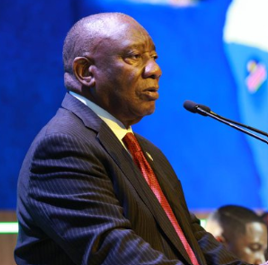
President Cyril Ramaphosa has called on member states of the Southern African Customs Union (SACU) to transform the regional bloc from a traditional customs arrangement into a dynamic industrial hub capable of shielding the region from global economic shocks.
The President delivered the keynote address at the opening of the 9th Summit of the SACU Heads of State and Government held at the Cape Town International Convention Centre on Friday.
He highlighted that as global uncertainties grow, no single African country can prosper in isolation.
“We gather today at a moment when the global economy is being reshaped before our eyes. Trade patterns are changing. New technologies are redrawing industrial competitiveness. Supply chains are being reconfigured. Around the world, nations are reorganising themselves for a far more uncertain future.
“It is at this moment when a re-imagined SACU Agenda matters," President Ramaphosa said.
Despite an increasingly unstable global environment, countries within the SACU region are showing economic resilience, with overall economic growth within the bloc projected to reach some 2.64% in 2026 and 2.1% in 2027.
To sustain this momentum, President Ramaphosa noted that the 116-year-old institution – the oldest customs union in the world – must adapt to changing global dynamics.
“Our Union has the potential to be more than a fiscal instrument. It must be a catalyst for development.
“It is time to move away from the traditional role of SACU as a customs arrangement and towards being the premier platform for regional economic resilience and self-reliance. This is essential because institutions that fail to adapt to changing realities ultimately become custodians of the past rather than architects of the future.
“Commendable progress has been made in a number of areas. Our ambition must be nothing less than building Southern Africa into one of the world’s most competitive regional production hubs,” he said.
The President called for collaboration between countries to build a robust industrial ecosystem capable of competing globally.
Specific national competitive advantages that can be harnessed include:
- Eswatini’s manufacturing base;
- Lesotho’s textile sector;
- Namibia’s green hydrogen and uranium processing potential;
- Botswana’s diamond beneficiation experience, and
- South Africa’s automotive and steel capacity.
“Industrialisation is the only durable path from commodity dependence to an economy capable of sustaining our growing populations.
“The next chapter in SACU’s history must be written not in customs schedules alone, but in factories that produce, laboratories that innovate, railways that connect our economies and young people whose talents are fully realised,” he insisted.
African endowment
President Ramaphosa noted that the African continent has about 30% of the world’s mineral reserves.
He said SACU must “leverage the growing global demand for critical minerals to support our own regional value chains and to fast-track the beneficiation of our raw materials”.
To clinch these opportunities, the region must continue to invest in infrastructure, including railways, roads, ports and energy grids.
“The Trans-Kalahari Railway, which Botswana and Namibia have been advancing, is precisely the kind of transformative infrastructure that the region needs.
“The Lesotho Highlands Water Project is a model of shared infrastructure that has served both Lesotho and South Africa for decades. Eswatini’s energy interconnections with South Africa and Mozambique demonstrate the same value.
“We are also launching cross-border special economic zones that will serve as nodal points for regional industrialisation,” President Ramaphosa said.
He emphasised that the continent possesses “everything the world needs for the next century of human development”.
“The question is whether we will be the architects of that development or merely suppliers of raw materials. This is the challenge we must address at this Summit.
“In the end, let history record that this generation of African leaders transformed the world’s oldest customs union into one of its most dynamic engines of regional development,” President Ramaphosa said. – SAnews.gov.za


