


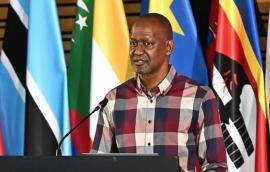
Southern African Development Community (SADC) Executive Secretary Elias Magosi has urged that member states must urgently translate discussions into concrete action to shield the region from escalating global shocks.
Speaking at the SADC Ministers of Foreign Affairs Retreat at Skukuza in the Kruger National Park, Magosi said the international system was undergoing one of the most profound transformations in modern history, driven by geopolitical rivalry, economic fragmentation and weakening multilateral cooperation.
Addressing ministers and delegates gathered in the wildlife-rich surroundings of the Kruger National Park, Magosi said the retreat comes at a critical moment when global instability is directly affecting Southern Africa’s development trajectory.
“It is both an honour and a profound responsibility for me to address this august Retreat of SADC Ministers of Foreign Affairs at a time when the international landscape is undergoing one of the most profound and consequential transformations in modern history,” he said.
Magosi said the global order was shifting in ways that could no longer be viewed as temporary disruptions, but rather a structural change in how power, trade and cooperation are organised internationally.
“The global order is experiencing a deep structural transformation characterised by intensifying geopolitical competition, economic fragmentation, technological rivalry, and growing uncertainty in international cooperation and multilateralism,” he said.
He warned that successive global shocks since 2020, including the COVID-19 pandemic, the Russia–Ukraine war, and escalating tensions in the Middle East, had exposed the region’s vulnerabilities and disrupted critical global systems.
“These events…have disrupted global systems in unprecedented ways, altering trade flows, investment patterns, energy markets, financial conditions, and geopolitical alignments, with far-reaching implications for the development of the region,” Magosi said.
The SADC Executive Secretary said the region must respond by strengthening economic resilience and accelerating industrialisation, food and energy security, and coordinated regional cooperation.
He said the retreat was designed to help member states reflect collectively on how to safeguard strategic interests and advance deeper regional integration in an increasingly uncertain world.
“This Retreat, therefore, provides a timely opportunity for Member States as a collective, to reflect deeply on how best to safeguard the Region’s strategic interests… and how to enhance our collective capacity to respond effectively and decisively to the increasingly uncertain global environment,” he said.
Magosi warned that the global system itself was being fundamentally reshaped, with trade, finance and strategic resources increasingly used as instruments of geopolitical competition.
“What we are witnessing today is not merely a temporary cycle of instability, but a fundamental reconfiguration of the global system itself,” he said.
He added that developing regions such as SADC remain highly exposed due to structural weaknesses, including dependence on imported energy, fertilizers, machinery and industrial inputs.
“Many of our Member States remain dependent on imported energy, fertilizers, machinery, and industrial inputs,” he said.
Magosi further highlighted rising debt burdens, limited economic diversification and constrained fiscal space as factors that amplify global shocks across the region.
He said recent disruptions to global supply chains and maritime logistics had demonstrated how vulnerable developing economies are to external shocks far removed from their own borders.
“These disruptions affect not only imports and exports, but also the affordability and availability of food, fuel, fertilizers, medicines, and industrial inputs essential for our economic activity,” he said.
Turning to agriculture, Magosi warned that rising input costs, climate variability and animal disease outbreaks were placing additional pressure on food systems and rural livelihoods.
“In the agricultural sector, the implications are especially serious,” he said, citing Foot and Mouth Disease among the challenges affecting productivity and food security.
Despite these challenges, Magosi said Southern Africa remains one of the most resource-rich regions globally, with vast reserves of oil and gas, critical minerals, renewable energy potential and strategic trade corridors.
“Few regions possess the combination of resources, geographic positioning, and market potential that SADC commands,” he said.
However, he cautioned that the region continues to export raw materials while importing higher-value goods, a pattern he said limits job creation and long-term economic transformation.
“In other words, we continue to export jobs and import inflation,” Magosi said.
He called for a stronger push toward industrialisation, value addition and beneficiation, as well as deeper investment in energy security and regional infrastructure.
Magosi also stressed the importance of strengthening the Southern African Power Pool, expanding cross-border energy trade, and investing in pipelines, refining capacity and renewable energy systems.
On infrastructure, he said efficient transport and logistics networks remain critical for regional competitiveness and integration.
At the same time, he called for improved domestic resource mobilisation and coordinated approaches to external financing and debt management, warning that financing arrangements are increasingly tied to access to strategic resources.
He said the proposed Regional Development Fund (RDF) could play a key role in reducing reliance on external funding and financing strategic regional priorities.
“The RDF offers an opportunity for SADC to mobilise resources for regional priorities, support strategic infrastructure and industrialisation programmes,” he said.
Magosi urged foreign ministers to expand the scope of diplomacy beyond politics to include economic transformation and strategic positioning in global affairs.
“Ministers of Foreign Affairs are therefore not only astute custodians of political relations, but also architects of the region’s collective engagement with the global economy and international system,” he said.
He called for greater policy coordination among SADC member states across trade, finance, climate, energy and global governance reform.
The Secretariat, he added, expects the retreat to produce practical outcomes that strengthen resilience, policy coherence and implementation of the regional integration agenda.
Magosi concluded with a strong call for confidence in the region’s own capacity to solve its challenges.
“We are adequate, we are capable, we are experienced, and we are talented enough to create a renewed, progressive, and truly integrated and resilient region,” he said. – SAnews.gov.za


