


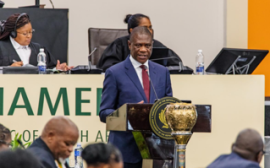
Deputy President Paul Mashatile has reaffirmed government’s commitment to ensuring access to sufficient, safe and reliable water, as parts of the country continue to grapple with supply challenges.
“We have come up with several resolutions that will assist provinces and municipalities and all water authorities to be able to manage our water supplies,” the Deputy President said on Thursday.
He was responding to Oral Questions in the National Assembly as part of Parliament’s oversight and accountability processes.
“One of the important issues that we have raised is that water authorities must maintain infrastructure, invest more in water infrastructure, and also attend to problems caused by leaks.
“We lose a lot of clean water through leakages or leaks all over the country. That's what we have emphasised to all these water authorities… to ensure that the bulk supply of water is reliable.
“Our challenge now remains reticulation, particularly in municipalities. That's where we're going to focus to ensure that municipalities, once water reaches the reservoirs in municipalities, the water must then reach households and businesses,” the Deputy President said.
As part of efforts to turn around the long-term decline in service delivery, National Treasury has introduced a performance-based incentive grant that will unlock R100 billion in investment to encourage metropolitan municipalities to deliver reliable water, electricity, sanitation, and refuse removal services.
READ | R100 billion incentive grant to improve service delivery in cities
"Metropolitan municipalities are now developing water and sanitation turnaround strategies, as part of the Reform of Metropolitan Trading Services Programme.
“One of the key reforms of this programme is to develop water and sanitation turnaround strategies, focusing on ringfencing revenue from the sale of water, specifically for the water function,” Mashatile said.
The implementation of these reforms seeks to stabilise and strengthen the delivery of core basic services in Metropolitan municipalities.
They will also set foundations for increased investment and economic growth in South Africa’s eight largest cities.
“To assist Gauteng municipalities in turning around water supply interruptions, the Department of Water and Sanitation has confirmed an increase of 200 megalitres in the water use license allocated to Rand Water.
“This expansion enables Rand Water to extract and treat additional volumes, a measure that will support the stabilisation of municipal water supply systems and strengthen delivery to households and businesses alike,” the Deputy President said.
Immediate relief is being secured through the commissioning of the Brixton Reservoir and insourcing of water tankers, while long-term stability will come from the 20 million litre Carlswald Reservoir and expanded Rand Water capacity.
These interventions, alongside leak repairs and stricter water use enforcement, will ensure that every household has access to a reliable, dignified water supply.
Transforming the economy
Meanwhile, the Deputy President stressed that abandoning Broad-Based Black Economic Empowerment (B-BBEE) is not an option.
The fundamental objective of the policy is to advance economic transformation and enhance the economic participation of black people in the South African economy.
“Abandoning BBBEE would mean abandoning transformation itself. BBBEE is a necessary tool for transformation, essential for achieving economic equality,” he said.
Instead, the government is embarking on a two-phase review of the B-BBEE framework led by the Minister of Trade, Industry and Competition, Parks Tau.
“The review will occur in two phases: a short-term review and a long-term review. The review aims to strengthen the execution of Section 9(2) of the South African Constitution, focusing on reimagining economic transformation and accelerating the participation of black South Africans in the economy,” he said.
Among other critical interventions, the two-phase review of the B-BBEE includes the following:
• Improve the effectiveness of B-BBEE implementation;
• Strengthen implementation gaps and compliance;
• Setting timelines for the achievement of milestones; and
• Provide for a strong linkage between B-BBEE, the growth path and industrial policy.
- SAnews.gov.za


