


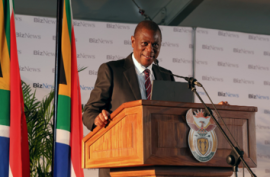
Deputy President Paul Mashatile has described the institution of traditional leadership as a living heritage which continues to shape South Africa’s destiny.
The Deputy President, in his capacity as Chairperson of the Inter-Ministerial Task Team on Matters of Traditional Leadership, engaged with the leaders in Limpopo on Friday.
The engagement forms part of government’s efforts to strengthen cooperation with Traditional leadership and advance the implementation of resolutions aimed at improving the lives of rural communities.
“To you, our revered diKgosi le di Kgosikgadi, we bow in respect. Your presence, drawn from the wisdom of the ancestors and the strength of our people, gives weight to this dialogue.
“In taking time from your many responsibilities, you affirm that the voice of Traditional Leadership remains a guiding star in the journey of our nation. We are humbled, for in your participation we see the living heritage that continues to shape our destiny,” the deputy president said.
Making progress
While acknowledging “remaining or rising concerns”, Mashatile outlined government’s progress in strengthening traditional governance, including the tabling of the Traditional and Khoi-San Leadership Bill of 2026 in Parliament.
“This marks a decisive step towards strengthening the legislative foundation of traditional leadership, ensuring that your voices are enshrined in law and carried forward with dignity.
“Grants have also been allocated to Traditional Councils, and induction workshops have been held for newly elected members, ensuring that Traditional Councils are capacitated to serve their communities.
“The construction and refurbishment of Traditional Council offices across districts further demonstrates the seriousness with which this province treats the institution of Traditional Leadership,” he highlighted.
Furthermore, the Handbook for Traditional and Khoi-San Leadership has been adopted and awaits concurrence from provinces.
“On the sensitive matter of disputes, Limpopo has established investigative committees and continues to process recognitions, document genealogies, and resolve succession matters. This is vital work, for it ensures that leadership is legitimate, respected, and rooted in custom.
“The review of remuneration and benefits for Traditional Leaders is being advanced at the national level, with the Independent Commission for the Remuneration of Public Office Bearers expected to submit its recommendations to the President by the end of June 2026. This will bring long-awaited clarity and fairness to the support extended to traditional leaders,” Mashatile added.
Other challenges – including the pending full concurrence for the handbook and vacancies in Traditional Councils – remain firmly in government’s view.
“These challenges are real, but I strongly believe that together we can find an amicable solution. It is for this reason that the National Government stands ready to collaborate with the Limpopo Provincial Government.
“Together, we will ensure that the Handbook is finalised and implemented, that disputes are resolved with fairness and legitimacy, and that tools of trade and financial support are extended equitably,” the Deputy President assured.
Working together
Mashatile urged traditional leaders to lead their communities from the front on social challenges including crime, social ills, climate resilience, initiation safety and the upcoming local government elections.
“As custodians of heritage and moral authority, you must mobilise communal structures to strengthen crime prevention, mediate disputes and reinforce accountability where formal policing is thin.
“In addressing teenage pregnancy, you have to be at the forefront of promoting values of responsibility and partner with clinics and schools to ensure young people receive both cultural and modern education.
“As stewards of communal land, you can tackle unemployment and poverty by facilitating cooperatives, encouraging youth entrepreneurship and ensuring fair distribution of social support,” he said.
The Deputy President also called for heightened vigilance as initiation season approaches.
“[It] is essential that we remain vigilant to safeguard the lives and dignity of our young initiates. While this tradition carries profound cultural significance, the growing presence of illegal initiation schools and unqualified practitioners poses serious dangers.
“These unlawful operations often disregard basic safety and health standards, exposing initiates to unhygienic conditions, malnutrition, physical abuse, and the absence of medical care risks that can turn a sacred rite of passage into a life-threatening ordeal. In other words, it is our responsibility to ensure that initiates go into the mountain alive and return home alive.
“We will work side by side to strengthen the customary initiation framework, safeguard the wellbeing of initiates and uphold the dignity of our traditions,” he stated.
On the topic of migration, Mashatile said government sought the cooperation of traditional leaders.
“Another area of responsibility that you as Traditional Leaders can assist the government with is the Comprehensive Approach for Migration Management aimed at strengthening border security, enforcing immigration laws, tackling corruption and closing policy loopholes as part of a broader effort to address illegal immigration in South Africa.
“Illegal immigration, if left unchecked, threatens not only the security of our borders but also the stability of our communities. It is therefore imperative that we work together to ensure that migration is managed in a way that is lawful, humane and just,” he said.
The Deputy President closed on a note of unity, describing the engagement as an opportunity to “engage in open communication, mutual respect and a willingness to listen”.
“As we pursue growth, it is crucial to ensure that our decisions are effective and that the concerns of various Traditional Leaders are addressed fairly and equitably.
“This opportunity is offered to either side, that is, the Government and Traditional Leadership.
“Today, we should collaborate and engage as partners rather than adversaries to unite our country and its people, regardless of the challenges that still persist,” Mashatile concluded. – SAnews.gov.za


