


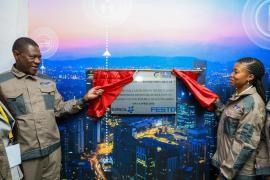
Government has established a Fourth Industrial Revolution (4IR) lab and a Centre of Specialisation in Mpumalanga for artisan training as part of efforts to cultivate a capable, skilled and competitive South Africa.
“These centres connect education with industry, empower young people with forward-looking skills, and position Technical and Vocational Education and Training (TVET) as a driver of economic growth and social transformation,” Chairperson of the Human Resource Development Council, Deputy President Paul Mashatile, said.
He made these remarks on Tuesday during the launch of the Gert Sibande TVET College 4IR LAB and Centre of Specialisation Millwright Workshop in the Mpumalanga Province.
“The work beginning here will ripple outward, motivating communities, empowering youth, and strengthening South Africa’s voice in the global dialogue on technology and human progress. Artificial Intelligence (AI) is reshaping cognition, operations, and problem-solving at a pivotal moment in history,” Mashatile said.
According to the World Economic Forum’s Future of Jobs Report 2025, by 2030, tasks will be nearly evenly divided between humans and machines.
AI may displace 92 million roles but create 170 million new jobs globally, a net gain of 78 million.
“Higher education institutions must partner in preparing people for jobs in the AI-driven economy. Those displaced must have pathways to retraining and strengthening their resilience.
“AI must also serve as a transformative force in rural industrialisation, evolving traditional economies into modern, diversified hubs.
“Integrating AI into agriculture, manufacturing, and services can enhance productivity, elevate product value, and expand market access. This is how we make the digital future equitable, inclusive and considerate,” he said.
The Deputy President said through the 4IR Digital Innovation Lab and Centre of Specialisation, government declares that AI will be harnessed to empower, not erode; to strengthen, not weaken; to ensure all stand as beneficiaries of transformation, not casualties of change.
“AI is not here to reduce human dignity, but to expand human potential. It is a partner in progress, a catalyst for creativity, and a bridge to new horizons. The question is not whether AI will transform society, but how and who will benefit.
“AI must be seen as a driver of economic development, enhancing productivity, fostering innovation, and creating opportunities. This laboratory, therefore, matters because it allows us to shape outcomes rather than react to them,” the Deputy President added.
It creates a platform for the institution to evolve into a hub of inclusive innovation, where research addresses societal needs and the future of work is shaped around people.
He emphasised that AI transformation must be guided by wisdom, compassion, and responsibility, ensuring technology becomes a bridge to inclusion, not a barrier to dignity.
“For South Africa, unemployment, inequality, and poverty, compounded by the digital divide, risk deepening exclusion. New jobs will arise in skilled sectors, leaving unskilled workers vulnerable to automation. Access to digital tools, affordable internet, and advanced skills remains inconsistent, limiting adaptation.
“Technology is a valuable tool, but it cannot lead development alone. Genuine advancement requires integration with human agency, cultural context, and moral leadership. Individuals, policies, and leaders are essential.
“We cannot afford to repeat those mistakes. This transformation must be guided by wisdom, compassion, and responsibility, ensuring technology becomes a bridge to inclusion, not a barrier to dignity,” Mashatile said.
He stressed that the success of AI will be judged not by efficiency alone, but by its ability to strengthen social cohesion, expand opportunities, and restore confidence in our collective future.
“South Africa’s successful adoption of AI will depend less on algorithms than on building a workforce skilled in data literacy, cloud computing, ethical governance, and applied AI integration. We must embed 4IR technologies into artisan training to ensure graduates are industry-ready.
“Our Government is developing a comprehensive response through the Draft National Artificial Intelligence Policy, released for public comment in April 2026. Once approved, it will establish national priorities, norms, and sector-specific strategies across manufacturing, energy, infrastructure, transport, and trade,” the Deputy President said.
The policy introduces interventions for capacity building and digital infrastructure, integrating AI into all levels of education to create a pipeline of talent.
It envisions AI hubs and super-computing facilities to empower startups and small enterprises, democratising access and distributing benefits across communities. -SAnews.gov.za


