


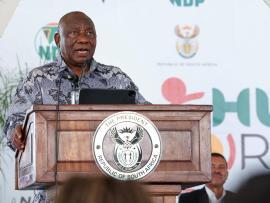
President Cyril Ramaphosa has issued a rallying call to all South Africans to embody the spirit of the Constitution through “action, thought, word and deed”.
The President delivered the keynote address at the national celebrations of Human Rights Day held in Kimberley.
This year marks 30 years since the Constitution was adopted by South Africa.
“Our Constitution is our moral compass. It does not change direction for individuals. It does not move for political parties or for the government of the day. No matter how turbulent the journey, advancing human dignity is the Constitution’s true north.
“In 1996, when the Constitution became law, we made a break with a divided past. Today, we work for a shared future. We have not yet reached the end of that journey. On this Human Rights Day, I call on each of us to rededicate ourselves to fulfilling the promise of the Constitution in action, thought, word and deed,” he said.
Former President Nelson Mandela signed the Constitution into law at Sharpeville – the site of the Sharpeville Massacre of the 21st of March 1960.
“It is significant that President Nelson Mandela chose to sign the Constitution into law in Sharpeville, the site of one of the apartheid regime’s worst acts of brutality.
“Today, on the anniversary of the Sharpeville Massacre of the 21st of March 1960, we honour the memories of all those who were killed in the struggle for human rights. It is fitting that the place that had known so much suffering and tears should be the site from which a new South Africa would rise,” he said.
A new democratic dawn
The Constitution’s adoption and signing into law was one of the final marks that South Africa had transitioned from the depravity and brutality of apartheid to freedom for all and democracy.
“Signing the Constitution into law was the most significant act of our democratic era. It was a clear moral commitment to build a society rooted in equality, freedom and human dignity.
“It set the coordinates for a journey towards a just, inclusive and united future for all South Africans. This is a journey that we remain on to this day. The Constitution is our greatest source of national pride not only because of what it contains, but because of how it was written,” President Ramaphosa noted.
The Constitution is a product of collective negotiations with several politicians, legal scholars, intellectual architects and negotiators participating in its formulation.
Often overlooked is the mass public participation that saw some 1.7 million submissions from individuals and civil society organisation – making it an inclusive body of legal work.
“For nearly a year and a half, we travelled through cities and villages, suburbs and townships, factories and farms to gather people’s contributions to the Constitution. We engaged with men and women, and with black, white, Indian and coloured South Africans alike. We met with young people with little experience of apartheid and with older people who still carried its painful wounds.
“We listened to the hopes, dreams and fears of middle-class and working-class South Africans, with the employed and the unemployed. We held community meetings, met with people at their places of work and study, and shared their views, concerns and proposals on the airwaves.
“Everyone who took part in these discussions had a deep understanding of why human rights mattered. In many cases, their views were born of their own personal experiences of injustice. Today we have a People’s Constitution, which every South African citizen of the time had a hand in writing,” President Ramaphosa reflected.
A constitution at work
President Ramaphosa stated that since its adoption, government and South Africans have worked “together to restore the dignity of all those who were denied this fundamental right” of human dignity and restoration.
“More than nine million learners in schools across this country are being fed through the National School Nutrition Programme. More than 29 million indigent, unemployed and vulnerable South Africans are receiving old age, disability and child support grants and other forms of social assistance.
“More than 80 percent of the population now have access to clean water and adequate sanitation, and more than two million poor households across this country receive free basic services.
“Our commitment to advancing the right to dignity enabled more than 800,000 students from low-income households to study for free at universities and colleges across the country last year alone,” President Ramaphosa said.
However, he added, that restitution is the “unfinished business of our democracy”.
“There can be no peace, no progress without justice. There are some who will say bygones should be bygones. There are some who say that there is no longer a need for affirmative action and employment equity targets, for land reform and restitution.
“Yet we say that restitution is not merely about compensation or redress. It is central to building a just society that upholds human dignity. If we are to give effect to the promise of our Constitution, we must continue to pursue policies of restitution and redress until our workplaces, our economy and the ownership of this country’s land truly reflect the diversity of the people of this country.
“We must continue until we fully deliver the social justice our people deserve,” he said.
The President called on all of society to join hands with government in fulfilling the promise of the Constitution.
“Addressing the gap between constitutional promise and lived reality is central to the legitimacy and vitality of South Africa’s democracy. Government cannot do this alone. We need to deepen partnerships between government, business, labour and civil society to create more jobs, uplift people from poverty and improve their material conditions.
“We must work together to combat social ills like gender-based violence, criminality and substance abuse. We need civil servants who are loyal to the constitution and treat people with dignity. Each and every one of us must be the champions of the Constitution.
“The faith that moved the drafters of the Constitution – the people of South Africa – lives on today. Let us continue along our journey, one and all, towards a South Africa of true equality where the dignity of all is not an aspiration, but a reality,” President Ramaphosa said. – SAnews.gov.za


