


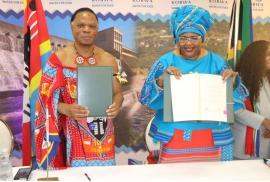
Water and Sanitation Minister Pemmy Majodina and Eswatini Minister of Mineral Resources and Energy, Prince Lonkhokhela Dlamini, have signed a revised treaty on the Development and Utilisation of the Water Resources of the Komati River Basin.
The amended treaty, signed at Maguga Dam in Eswatini on Friday, 13 March 2026, supports future water development, while safeguarding long-term water security for communities in Mpumalanga relying on the Driekoppies Dam and Maguga Dam, and reinforces strong transboundary cooperation between South Africa and Eswatini.
The agreement was concluded during a meeting hosted by Prince Dlamini, who invited Majodina to the Kingdom of Eswatini to discuss cooperation on shared water resources and to further strengthen bilateral relations between the two neighbouring countries.
The Ministers emphasised the need to strengthen cooperation and the existing bilateral relations through the Joint Water Commission (JWC) Agreement signed in 1992. The Commission acts as a technical advisory body to both governments on all technical matters relating to the development and utilisation of shared water resources.
The Kingdom of Eswatini and the Republic of South Africa also signed the Treaty on the Development and Utilisation of water resources of the Komati Basin in 1992, which led to the establishment of the Komati Basin Water Authority (KOBWA) in 1993. The bi-national authority was mandated to raise financing through loans, design and oversee the construction of the Maguga and Driekoppies dams, and to manage their operation and maintenance.
The Treaty stipulated the equitable water allocations between two countries and set out a formula for sharing the costs of construction of the two dams as well as operation and maintenance of the dams and the system post construction phase.
However, the agreement had not been reviewed in the 33 years since its signing. With the introduction of many legislative changes in the Kingdom of Eswatini and the Republic of South Africa, environment in which KOBWA operates and commitments to international principles governing transboundary water cooperation between member states amongst others, necessitated a review of the treaty.
The revision aims to broaden KOBWA’s mandate so that it can support the two governments’ efforts to improve water services for their citizens and explore sustainable revenue streams to support its operational expenses.
The review process included public consultations in both countries, and all relevant processes for concluding international agreements were observed from both countries.
During the meeting, the Ministers stressed the importance of complying with minimum cross-border water flow requirements at the Ressano Garcia gauging station in line with the Incomati–Maputo Watercourse Agreement. They also encouraged KOBWA and the Inkomati-Usuthu Catchment Management Agency (IUCMA) to work together towards ensuring the 2.6 m3/s (cubic metres) is achieved as prescribed in the Incomati-Maputo agreement.
“The Ministers further committed their support to the Incomati-Maputo Water Commission (INMACOM) as the new institution established to promote cooperation between the three Parties (The Kingdom of Eswatini, The Republic of Mozambique and The Republic of South Africa) to ensure the development, protection and sustainable utilisation of water resources shared by the Member States,” the Ministers said in a Joint statement.
The meeting reaffirmed the continued strong cooperation between the two governments, especially in the management of transboundary water resources.
It was agreed that the Joint Water Commission would continue to meet at least once a year, while the Ministers would hold regular engagements to share updates and discuss progress on the work of the Commission. – SAnews.gov.za


