


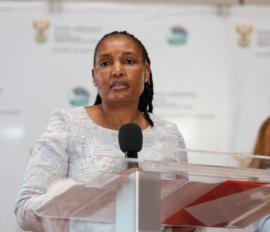
Human Settlements Minister Thembi Simelane has announced two national initiatives aimed at strengthening municipal capacity and creating employment pathways for graduates, as government intensifies efforts to professionalise South Africa's human settlements sector.
Speaking at the opening of the International Pan-African City Symposium and Exposition and the launch of the Institute of Human Settlements Practitioners South Africa (IHSP-SA) at Nelson Mandela University on Monday, Simelane said the sector required stronger institutional capacity, skilled professionals and innovative approaches to address growing urbanisation, climate risks and housing backlogs.
The symposium was held under the theme: "Smart Futures Villages to Smart Economies – Exploring Models that Create Resilient, Equitable, Regenerative and Thriving Communities."
Simelane said the newly launched institute would play a critical role in advancing professional standards, ethical practice, research and skills development across the human settlements sector.
"The launch of this institute is not an accidental event. It is the result of years of ideas, advocacy, academic work, sector mobilisation and commitment to the recognition of Human Settlements as a serious field of knowledge, practice and public service," the Minister said.
Special project to strengthen municipalities’ capacity
As part of government's professionalisation agenda, Simelane announced a National Special Project aimed at assessing and strengthening the capacity of municipalities and provinces to plan, develop and manage human settlements programmes.
The initiative, to be undertaken in partnership with the Presidency, will focus on identifying institutional weaknesses and improving the ability of municipalities, particularly accredited municipalities and secondary cities, to deliver housing and human settlements projects.
The Minister also announced the development of a National Strategy for the Engagement of Housing and Human Settlements Graduates, aimed at creating structured pathways into the sector for university graduates.
"Over the years, universities have produced graduates in housing and human settlements programmes. These graduates possess skills, knowledge and attributes that are directly relevant to the sector. Yet many of them do not find structured pathways into the Human Settlements system," Simelane said.
The strategy will focus on structured experiential learning, formalised internship models, youth entrepreneurship initiatives to enrich the human settlements sector, and the integration of graduates into areas such as social facilitation, data infrastructure, and local government support.
Additional focus areas include beneficiary management, affordable housing development, title deed acceleration, and the adoption of modern, sustainable construction techniques.
Simelane urged all provinces, including metropolitan municipalities, human settlements entities and non-governmental organisations to prioritise specialised human settlement development qualifications when recruiting for sector-related positions.
“Contractors, developers, and service providers in human settlements technical projects need to do the same by creating opportunities for these graduates This does not mean that other relevant qualifications are excluded. It means that Human Settlements qualifications must no longer be invisible in the sector they were designed to serve,” the Minister said.
She also called on universities and the Department of Higher Education and Training to explore mechanisms that would enable graduates burdened by historic student debt to access their academic certificates and enter the workforce.
The launch of the institute comes as government moves to implement the Human Settlements White Paper approved by Cabinet in 2024, which calls for stronger sector capacity, minimum competency standards and the professionalisation of human settlements practice.
Simelane said the department will formalise a cooperation agreement with the institute to support capacity development, research, professional standards, continuous professional development and graduate support. – SAnews.gov.za


