


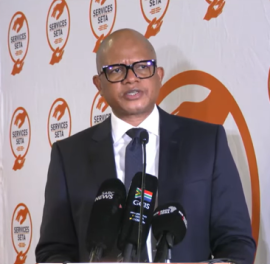
The Services Sector Education and Training Authority (Services SETA) has committed to restoring justice for employees dismissed after raising concerns about alleged irregularities, signalling a shift toward stronger protection for whistleblowers.
Speaking at a media briefing on Friday, Services SETA Administrator Lehlogonolo Masoga outlined steps being taken to address cases involving three former employees believed to have suffered occupational detriment after making protected disclosures.
The briefing follows a recent update by Higher Education and Training Minister Buti Manamela on progress at entities placed under administration, including the Services SETA.
READ | Department’s interventions restore governance and trust in SETAs
Masoga said the organisation had undertaken a comprehensive legal review process, including internal assessments, independent external evaluations and senior counsel input, to determine whether the dismissals were linked to whistleblowing activities.
“The process was guided by a victim-centred restorative justice approach, ensuring fairness, transparency and the protection of those who acted in the public interest,” Masoga said at the briefing in Pretoria.
The move comes amid growing national attention on whistleblower protection, particularly following remarks by President Cyril Ramaphosa during the 2026 State of the Nation Address, where he reaffirmed plans to introduce legislation criminalising retaliation against whistleblowers.
Masoga emphasised that existing legal frameworks, including the Protected Disclosures Act 26 of 2000 and the Labour Relations Act, prohibit any occupational detriment against employees who disclose wrongdoing in good faith.
Cases under review
The review focused on three former employees dismissed between 2017 and 2020.
In the case of Lehloma Ramajoe, Masoga said independent findings confirmed that the employee suffered an occupational detriment as he was disciplined, suspended or dismissed “on account, or partly on account, of having made a protected disclosure.”
Ramajoe alleged that he disclosed information of maladministration within the Services SETA to at least seven individuals or entities, including the then two erstwhile Chairpersons of Services SETA; the National Skills Authority; Parliamentary Portfolio Committee (presumably of Higher Education and Training); then Minister of Higher Education and Training; the Public Protector; and OUTA.
“It was independently confirmed that Mr Ramajoe has suffered an occupational detriment as he was disciplined, suspended or dismissed “on account, or partly on account, of having made a protected disclosure. It follows that the Administrator should afford Mr Ramajoe a remedy in accordance with the provisions of section 193 and/or 194 of the LRA [Labour Relations Act].
For Thandi Mkhize, the Administrator said there were reasonable grounds to conclude she was targeted after raising concerns about irregularities. As she has reached retirement age, compensation is being considered as the appropriate remedy.
In July 2017, Mkhize was charged for misconduct for allegedly sharing information with the union members on a matter she considered irregular. She was subsequently dismissed and her attempts to challenge the dismissal through the Commission for Conciliation, Mediation and Arbitration (CCMA), and Labour Court did not bear fruit.
“Upon review of the facts at my disposal and on legal advice, there is reasonable grounds to conclude that the employee was deliberately targeted and may have been exposed to occupational detriment as a result of raising various issues of irregularities as per the provisions of Protected Disclosure Act,” the Administrator said.
In the case of Tshepiso Mofokeng (Mngceke), findings indicate her dismissal followed disputes with management over alleged maladministration, including concerns about the appointment of a service provider. Despite a prior settlement, the matter meets the threshold of a protected disclosure case and may warrant further remedial action.
Masoga acknowledged institutional failures and accepted responsibility on behalf of the organisation.
“We take full responsibility for the actions and inactions of our predecessors and commit to dispensing justice to the victims.”
He added that the whistleblower review process is running alongside efforts to hold accountable those implicated in wrongdoing within the entity.
Towards restorative justice
Masoga said the approach adopted reflects principles of restorative justice, including acknowledging harm, involving affected parties and ensuring corrective action.
He noted that whistleblowers often face severe consequences, including loss of employment and, in some cases nationally, threats to their safety.
Masoga reaffirmed the Services SETA commitment to justice through timeous and decisive action in pursuit of good governance.
“I wish to state categorically the Services SETA has its own internal policy on whistleblowing and further that this process is running parallel to other efforts to ensure that decisive and concomitant action is taken against those who committed act[s] of irregularity and malfeasance. The Minister’s decision to put the entity under administration was primarily for the purpose of addressing among others challenges of this nature.
“Restorative justice incorporates among other elements active participation by the affected parties, taking responsibility and commitment to repair damages, and a victim-centred approach. It is for this reason that on behalf of the Services SETA, I take full responsibility for the actions and inactions of my predecessors and commit to dispense justice to the victims of our previous decisions and/or sometimes lack thereof,” he said. – SAnews.gov.za


