


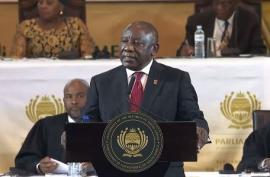
President Cyril Ramaphosa says the deployment of the South African National Defence Force (SANDF) to assist the South African Police Service (SAPS) is expected to significantly reduce serious and violent crime in targeted areas affected by gangsterism and illicit mining.
The President was responding to oral questions in the National Assembly on Thursday, following a question about the measurable outcomes and public safety improvements expected from the deployment.
President Ramaphosa said the SANDF will act as a “force multiplier” to support police operations aimed at tackling gang violence in the Western Cape, Eastern Cape and Gauteng, as well as illegal mining activities in Gauteng and the North West.
“The SANDF deployment is necessary to complement the efforts of SAPS in tackling these crimes and bringing stability to communities,” the President said.
He explained that soldiers will operate under police command, with clear rules of engagement and for specific, time-limited objectives.
According to the President, SANDF members may assist by providing protection during high-risk police operations, supporting cordon-and-search operations against armed criminals and securing critical infrastructure.
This support will allow police officers to focus on investigations, arrests and building strong cases that lead to successful prosecutions.
The deployment will also form part of broader interventions that include strengthening anti-gang units and illegal mining task teams.
Police will work alongside the National Prosecuting Authority through multidisciplinary task teams aimed at dismantling criminal networks by targeting their leadership, finances, firearms and logistics.
“Through this support we aim to achieve a significant reduction in serious and violent crime across targeted areas of deployment with the neutralisation of gang violence and illicit mining,” President Ramaphosa said.
National Health Insurance
Meanwhile, responding to a separate question from Julius Malema of the Economic Freedom Fighters, the President outlined progress made toward implementing the National Health Insurance Act.
President Ramaphosa said government is undertaking preparatory work to implement the NHI, which aims to provide universal health coverage for all South Africans.
This includes developing procedures for registering NHI users, establishing accreditation frameworks and contracting arrangements for healthcare providers.
Government is also rolling out digital health systems to allow patient records to be tracked across both public and private healthcare facilities.
These systems include a Health Patient Registration System linked to the Department of Home Affairs’ population register and an Electronic Medical Record system expected to be rolled out to more than 3 500 public healthcare facilities over the next 15 months.
The President said government is also investing in healthcare infrastructure through the rebuilding of older hospitals and construction of new hospitals, clinics and health centres, while improving hospital governance.
Efforts are also underway to employ more doctors, health professionals and community health workers.
President Ramaphosa noted that government has undertaken not to proclaim sections of the NHI Act until the Constitutional Court of South Africa has ruled on legal challenges relating to the public participation process followed during the adoption of the legislation.
The cases are expected to be heard in early May 2026.
He said the undertaking, which has been made an order of court, will not affect the overall timetable for implementing the NHI or halt the work currently underway.
“The NHI aims to establish a single national fund that will allow for the equitable purchasing of health services from public and private healthcare providers,” the President said.
President Ramaphosa emphasised that the reforms introduced through the NHI are complex and will be implemented gradually in line with available financial resources.
“We are determined to ensure that every South African has equal access to quality health care regardless of their ability to pay,” he said. – SAnews.gov.za


