


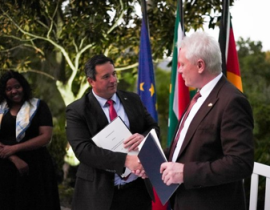
South African Agriculture Minister John Steenhuisen and Germany’s Federal Minister of Agriculture, Food and Regional Identity, Alois Rainer, have signed a Joint Declaration of Intent on Agricultural Development aimed at strengthening bilateral cooperation on the control of Foot and Mouth Disease (FMD) and trade in animal products.
The landmark agreement, signed Tuesday evening in Cape Town, marks a significant diplomatic milestone and signals a renewed cooperation between the two countries, focusing on the crucial challenges of biosecurity and agricultural trade.
The declaration comes as South Africa continues efforts to contain outbreaks of FMD affecting parts of the country’s livestock sector.
Steenhuisen welcomed the agreement, saying the partnership provides a vital lifeline of technical expertise and innovation.
“This is not just a document; it is a powerful tool that will help us safeguard our livestock industry and secure the livelihoods of our farmers,” the Minister said.
Under the declaration, the two countries have identified five key areas of cooperation. These include the exchange of knowledge and best practices on outbreak prevention and FMD containment, with a specific focus on strengthening biosecurity measures in animal husbandry and veterinary services.
The agreement also includes cooperation on wildlife monitoring systems to develop robust FMD monitoring systems, particularly for wildlife populations.
In addition, the two countries will explore advances in FMD immunisation, including the application of mRNA technologies.
Further areas of collaboration include collaborative research and development on diagnostic tools, specifically 'differentiating infected from vaccinated animals' (DIVA) tests, as well as research into managing FMD risk materials in controlled slaughter environments.
Steenhuisen said the signing of the Joint Declaration arrives at an imperative juncture for the South African agricultural sector, offering a structured pathway to modernising disease control.
“This collaboration goes beyond immediate crisis management. It paves the way for a long-term exchange of expertise, trade development, skills enhancement, and the integration of cutting-edge technology and innovation in agriculture,” Steenhuisen said. – SAnews.gov.za


