


In the vast, arid land of the Namaqua in the Northern Cape – curtained only by rugged hills and rocky mountains – the ancestral remains of 63 Khoi and San peoples have finally come home to rest.
During a timespan lasting nearly 60 years between 1868 and 1924, the remains were removed from their homeland without consent for race-based scientific research by colonial Europeans – stripping them of the right to rest with dignity.
The remains were finally repatriated last year from the University of Glasgow in Scotland, where they had been housed at the Hunterian Museum.
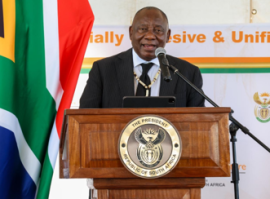
Delivering remarks at the solemn reburial ceremony held just outside Steinkopf in the Northern Cape, President Cyril Ramaphosa assured that the “greatest tragedy of the erasure of the indigenous peoples of southern Africa is that much of it went unacknowledged”.
He assured that the South African government, however, will not shy away from restoring the dignity of those who were discriminated against and marginalised.
“Even amidst the emergence of serious critiques on the part of these European powers in the late 1970’s, many have avoided a deeper reckoning. Some of these countries have apologised for specific atrocities, but in the main, they have fallen short of full, unqualified apologies for colonialism as a whole.
“As democratic South Africa, we do not linger in the shadow of unspoken apologies or deferred reckonings. We will restore dignity - on our own terms.
“The return of our ancestors to their descendant communities is a vital act of restoration and restitution that goes beyond acknowledging the colonial legacy; it is also a manifestation of ubuntu – a recognition of our common humanity,” the President said on Monday.
WATCH | Reburial ceremony
Healing wounds
Following their repatriation from Scotland, the remains were received in a welcoming ceremony and subsequently placed under the care of the Iziko Museums of South Africa in Cape Town.
The remains then made their way home, up, over and through the twists and turns of N7 the national road, to be received by the Northern Cape government in an official handover ceremony from the Western Cape.
In true South African style, traditional spiritual rites were performed and a night vigil was held the day before the formal reburial ceremony at the Kinderlê-monument just outside Steinkopf in the province.
At the ceremony – where the past, present and future of the Khoi and San peoples gathered – Chairman of the National Griqua Council Barend van Wyk described to SAnews.gov.za the pain associated with the “exploitative and humiliating” illegal removals all those years ago.
“Emotionally, it’s hard. The fact that they dug up our ancestors’ remains…why did they do that to human beings? Were our people not worthy of being human that they had to be dug up?
“But we are glad today, although there is pain and hardship, that we can finally reinter them in the land of their birth,” van Wyk said.
Dionne Barley, a direct descendant of the people whose remains were taken, said the day was a moment for reflection.
“I feel very happy as somebody that is closely related to some of these people that are buried here. I feel good that they are now being buried in dignity [and] that they are not sitting in museums and that the President actually ensured that they could come back to South Africa and back to their rightful place,” Barley told SAnews.
The modern story of the indigenous people of South Africa cannot be told without the mention of Ouma Katrina Esau.
The nonagenarian is a legend not only among her people but also in South Africa – taking her place as the last remaining fluent speaker of the critically endangered N|uu language.
“I did not think I would make it here as I have been so sick. But it was my dream to be here and to be with these people, so that I can also say that I was there, even if it’s to bury their bones. I am so very thankful because God protected us. I am very glad to be here,” she said.
An act of justice
The process of repatriation and reburial was jointly facilitated by the Department of Sport, Arts and Culture (DSAC) and its entities in the South African Heritage Resources Agency and Iziko Museums.
Chairperson of SA Heritage Resources Agency, Elodie Seotseng, Tlhoaele told SAnews that the process was about the restoration of respect and human dignity.
“Today, we are seeing the culmination of a process that sought to restore the human dignity of ancestors that were taken away from this land…exhumed from their graves and taken to foreign lands for scientific…academic research and for display to be consumed as objects. So, we are here to re-instil and restore that respect and human dignity to those ancestral remains in their homeland.
“This is a land and a space that is already hallowed ground. This space is a burial ground for children who were victims of clan wars, and it is already a heritage site. Just over the hill is also a burial site of casualties of war. So, it’s significant, this is hallowed ground,” she explained.
The remains are buried in individual graves – a grace not previously afforded to the peoples of this land by colonial masters.
“Each grave has been demarcated. So, it’s not a mass grave; it’s individual graves in one area. That goes back to our insistence on instilling human dignity and respect in whichever state the human being is in,” she added.
As the sun set on the Kinderlê monument where the remains now rest, President Ramaphosa emphasised that government’s work to implement the National Policy on Repatriation and Restitution of Human Remains and Heritage Objects and to restore dignity for all continues.
“Through the National Policy...we will continue to forge partnerships with institutions and individuals across the world to recover ancestral human remains that were illegally taken from South Africa,” President Ramaphosa said.
READ | President Ramaphosa to officiate reburial ceremony of Khoi-San ancestral human remains
– SAnews.gov.za


