


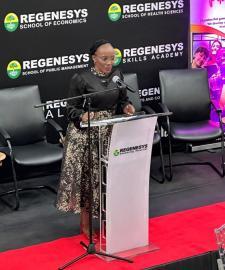
Minister in the Presidency for Women, Youth and Persons with Disabilities Sindisiwe Chikunga has underscored the importance of forging stronger partnerships across government, business and academia to accelerate women's economic empowerment.
Delivering the keynote address at the 8th Annual Regenesys Women in Business and Leadership Conference in Sandton on Wednesday, Chikunga said no single sector could achieve an inclusive economy on its own.
She emphasised the importance of ensuring that inclusive growth benefits all women, particularly young women, women with disabilities and in rural and township communities.
Held under the theme, "Building an Inclusive Economy – The Role of Government, Business and Academia", the conference brought together leaders from government, business and academia to explore practical solutions for advancing women's economic participation.
Chikunga said government, business and academia are the three pillars of a functional economy and must work together rather than in isolation.
"Government cannot legislate its way to inclusion without the productive capacity of industry players. Businesses cannot thrive without the enabling framework and stability of an innovative public service, and neither government nor business can build a workforce, or a citizenry, capable of driving inclusion — without academia.
“If we are to achieve real results, these three pillars must move in unison, not in parallel; in partnership, not in silos,” Chikunga said.
The Minister stressed that meaningful partnerships should focus on creating opportunities for women and other vulnerable groups by investing in education, skills development, entrepreneurship and access to finance.
She called for a new generation of public-private partnerships centred on human capital development, saying these collaborations can bridge financing gaps, accelerate service delivery, strengthen innovation and improve the quality of public services.
However, Chikunga warned that partnerships must be guided by equity, transparency, accountability, and sustainability, to ensure they benefit those most in need rather than entrench existing inequalities.
She acknowledged early childhood development, technical and vocational education, healthcare, digital infrastructure and innovative financing are key sectors where collaboration between government, business and academia could drive inclusive economic growth.
The Minister also highlighted Africa's youthful population as both an opportunity and a challenge, warning that the continent's demographic advantage could become a liability without sustained investment in the health, education and wellbeing of young people.
"A demographic dividend is not automatic. Without deliberate, massive and sustained investment in the health, education and wellbeing of our young people, our demographic bulge could become a demographic disaster — with youth unemployment, social instability, and lost potential as our legacy," the Minister said.
Women's financial inclusion
Turning to women's financial inclusion, Chikunga outlined several priority areas requiring urgent action, including increasing women's participation in economic decision-making, expanding access to financial resources and capital, and recognising the care economy as a critical enabler of women's economic participation.
Among the measures proposed were specialised banking initiatives for women, expanded microcredit programmes, gender-responsive financial technology and strengthening public procurement opportunities for women-owned businesses.
The Minister also called for greater investment in affordable childcare, flexible workplace policies and shared household responsibilities to reduce the unpaid care burden that continues to limit many women's participation in the economy.
Tribute to generations of women
Addressing delegates during Women's Month, which this year marks the 70th anniversary of the 1956 Women's March, Chikunga paid tribute to generations of women who fought against discrimination and exclusion.
She urged stakeholders to honour their legacy by translating commitments into measurable action.
"As we mark the Platinum Jubilee of the 1956 Women's March, let us leave this conference committed to concrete action, with timelines and accountability, and with the understanding that we owe the next generation of women more than we inherited," the Minister said. – SAnews.gov.za


