


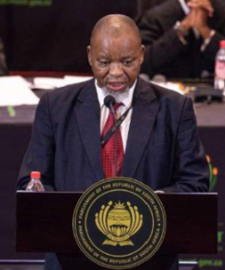
Minister of Mineral and Petroleum Resources Gwede Mantashe has tabled the department’s R2.86 billion budget in Parliament today.
Operational allocations include:
- R70.46 million for the South African Diamond and Precious Metals Regulator.
- R94.98 million for the Petroleum Agency South Africa (PASA).
- R666.9 million for the Council for Geoscience.
- R328.7 million for Mintek.
- R4.89 million for the Mine Health and Safety Council.
Project-specific allocations include:
- R23.48 million for the Mine Rehabilitation Research Project.
- R140.87 million for the Rehabilitation of derelict and ownerless mines.
- R48.1 million for the implementation of the Shale Gas Project
- R33.83 million for the Mine Water Ingress Project.
- R31.12 million for the Artisanal and Small-Scale Mining Project.
The budget, Mantashe said, is government’s response to global challenges arising from conflict and a sluggish economy.
“We are tabling this Budget Vote during a difficult period in the global economy. A time when conflict rages in the Middle East with its tremors felt far beyond its frontlines, destabilising global energy supply chains and casting a long shadow over our own economic recovery.
“In this era, where energy security is intrinsically linked to national stability, we cannot stand on the sidelines and be passive observers. This budget is our strategic response to these geopolitical realities, a commitment to protecting the livelihoods of our people, securing our energy future, and anchoring our economy against the rising tides of international instability and price volatility,” Mantashe said.
Central to the strategic response is an acceleration of the Upstream Petroleum Industry and a determined push to expand South Africa’s refining capacity, despite what the minister described as “persistent pressure from certain environmental lobby groups”.
“The fact remains that petroleum security is not a theoretical debate, but an economic necessity and a national imperative.
“For this reason, it is imperative that we accelerate processing of the South African National Petroleum Company Bill [SANPC] to enable the full operationalisation of the SANPC as a strategic state-owned entity to enable meaningful and strategic state participation in the oil and gas sectors, as envisioned in the Upstream Petroleum Resources Development Act [UPRDA],” Mantashe said.
In that same vein, the moved to calm any public anxiety over fuel supply.
“While global fuel supply challenges persist, I would like to assure the people of South Africa that we have sufficient fuel supply to meet demand, and that our fuel supply remains stable.
“Working closely with industry stakeholders, we continue to monitor the supply situation and will ensure ongoing transparency in this regard,” he said.
The mining industry
Mantashe noted that despite global headwinds, the sector is demonstrating resilience and “remains a cornerstone of our economy”.
“South Africa’s mining Gross Value Add reached R477 billion in 2025, contributing approximately 6.3% to the country’s Gross Domestic Product (GDP). This growth was driven largely by strong iron ore and manganese exports, improved commodity prices, and strong sectoral performance during the first three quarters of the year.
“Mining royalties collected into the fiscus totalled approximately R11.8 billion in 2025, marking an increase of 11% from the R10.6 billion recorded in 2024,” he said.
The Minister acknowledged that despite the continued resilience, the sector still faces challenges with rising the rising cost of electricity placing “severe operational pressure on mining companies, particularly deep-level gold and Platinum Group Metal [PGM] operations”.
Turning to the Critical Minerals and Metals Strategy, Mantashe told the House that the era of dormant policy documents was over.
“House Chairperson, last year, we made a solemn commitment to this House that the Critical Minerals and Metals Strategy would not become a document destined to gather dust on a shelf. We said, it must become a shovel in the ground and a magnet for investment.
“Today, we are happy to share with you that the era of passive policy is over. We have moved decisively from blueprint to battlefield, aggressively actioning the framework to secure a seat at the head of the global critical minerals dialogue and transactions.
“We are transforming our mineral endowment into a catalyst for industrialisation, investment, and economic growth. I can assure you that we are not just planning for the future, we are actioning it,” he insisted.
One of the key pillars of the strategy is geoscience mapping and exploration.
The minister said through the Council for Geoscience (CGS), government is investing in “high-resolution geoscientific data aimed at derisking exploration and attracting investment”.
“We can report that through its Integrated and Multi-Disciplinary Geoscience Mapping programme, the CGS has increased national onshore mapping coverage from below 5% in 2019 to a cumulative 20% in the 2025/26 financial year. The CGS will continue scaling this flagship programme across both onshore and offshore domains, with a focused effort on generating and disseminating high-quality pre-competitive geoscience data.
“This data can be accessed through the Virtual Core Library – launched at this year’s Mining Indaba – which serves as a strategic national asset designed to transform how South Africa unlocks value from its geological assets,” Mantashe revealed.
Furthermore, the R400 million Junior Mining Exploration Fund has funded some 13 projects with exploration already underway at sites including Giyani and Bothaville.
Mine safety and policy
Mantashe told the House Mineral Resources Development Bill is undergoing legal certification at the Office of the Chief State Law Advisor before heading to Cabinet for approval.
It is anticipated that the Bill will then be introduced to Parliament in the second quarter.
The Mine Health and Safety Bill aimed at embedding compliance as a core business function “rather than an administrative exercise” is before Parliament.
“Once enacted, this legislation will strengthen accountability, tighten operational requirements, improve enforcement measures, and further our commitment towards achieving the goal of zero harm.
“Notwithstanding the ongoing review of the policies, it is encouraging that the sector is already making strides towards attaining the goal of zero harm, as evidenced by a historic 41 fatalities recorded in the 2025.
“The Ekapa disaster, which claimed five lives, is a stark reminder that complacency has no place in this industry. Investigations regarding the disaster are already underway, and we will ensure that no stone is left unturned in uncovering the facts surrounding the disaster,” Mantashe noted. – SAnews.gov.za


