


By Thulani Mdakane
Many decades later, the colonial and apartheid impact of land dispossession lingers on and continues to define the current skewed patterns of land ownership and access. Legislative measures, such as the Natives Land Act of 1913 and the Group Areas Act of 1950, facilitated the removal of many Black individuals from their ancestral lands, depriving them of their inherent rights to land ownership in their native country.
This system of discrimination perpetuated racial subjugation and social exclusion, manifesting through forced removals, evictions, and ongoing tenure insecurity in the land that Black people had previously owned. Some Black landowners, who effectively farmed their land for crops and livestock, had their properties unjustly confiscated.
Consequently, many were compelled to become tenants and labourers for the new white landowners, to whom the government had allocated this land without just cause. Homes of families who had lived in vibrant, multiracial neighbourhoods since time immemorial were destroyed, and people were expelled to underdeveloped, overcrowded, and remote townships. In some traditional communities under the jurisdiction of Amakhosi and Kings, productive land was lost to commercial agriculture, forestry, and biodiversity conservation.
All of these were brutish and brutal acts of injustice that decimated the dignity and self-worth of all those who were victims of land dispossession, alienating them from land, which is a critical productive asset that generates wealth and sustains livelihoods for their families and communities.
Invariably, the struggle for freedom and democracy had the question of land ownership and access at its core as part of a transformative national agenda to achieve restorative justice, equitable land access, and foster national cohesion. It was a national agenda grounded in the respect for the human rights of all those who suffered the indignity of an unjust system.
Since 1994, the democratic government has always understood the constitutional injunction of redress through the implementation of the land reform programme that foregrounds land restitution, land redistribution, and tenure reform. Land transformation and spatial justice are not acts of punitive vengeance against apartheid-era land beneficiaries but are key pillars of responsibly guided constitutional imperatives of redress, economic inclusion, and nation-building.
Over the years, the land reform programme has restituted and redistributed vast hectares of land to many beneficiaries across the country for productive use in agriculture, human settlements, and industrial development. While a great deal of progress has been made, there is still more work to be done to address the backlogs and ensure the optimisation of limited fiscal resources to accelerate and enhance the effective implementation of land reform programmes.
There is still more work needed in the provision of post-settlement support to beneficiaries to ensure that restituted farms are kept productive. Targeted support is also critical in enhancing the productive utilisation of communal land to advance the goals of rural development in partnership with traditional leaders.
Through the work of the Inter-Ministerial Committee on Land Reform and Agriculture chaired by Deputy President Mashatile, Government continues to leverage a collaborative intergovernmental platform to provide leadership and oversight to ensure that various components of the government system help unblock challenges faced by claimants and beneficiaries who seek urgent support from Government, including the speedy finalisation of land transactions, post-settlement support packages, and handing over of title deeds.
At the level of the Presidency, the President and the Deputy President are working with relevant departments and government entities to speed up the processing and handover of title deeds to qualifying beneficiaries. The core leadership message is that those who have been given back the land must till the land, make it productive, and create sustainable employment, contributing to local economic development while ensuring that this asset generates wealth for households for generations to come.
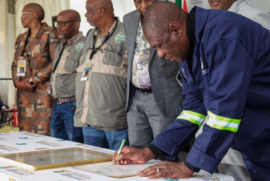
On the 13th of March 2026, Deputy President Paul Mashatile, together with the Minister of Land Reform and Rural Development, Mr Mzwanele Nyhontso, handed over land and title deeds to the Mtsweni family, whose claim is registered as Schulk Marhiqa CPA, in Govan Mbeki Local Municipality in Mpumalanga. The land comprised 18 households and 86 beneficiaries and measures more than 627 hectares, specifically Portions 24 and 26 of Grootvlei Farm.
The family had once owned a substantial portion of this land before it was taken under the Natives Land Act of 1913 and allocated to the Frans Herbs family. Deputy President Mashatile characterised this handover as evidence of government’s unwavering commitment to restorative justice and redress.
When addressing the gathering, the Deputy President said: “This handover is a testament to the ongoing pursuit of justice, and each hectare restored is a meaningful step towards healing historical injustices and reaffirms our resolve to building a fairer and more equitable South Africa. It is also a fulfilment of a promise we made in 1994 that land would be returned to its rightful owners.”
The Deputy President and the leadership at the handover ceremony recognized the Schulk Marhiqa CPA as a commendable example of family cohesion and robust institutional governance that will facilitate productive use of restituted land. The CPA has commenced farming on 100 hectares of maize and 30 hectares of soya beans, and is actively engaged in livestock production, including cattle and goats.
To ensure its long-term viability, Government has provided R16,585,627.80 for support, specifically targeted at bolstering livestock farming, grain production, and essential skills development for the claimants. Government will continue to provide mentorship and market access support to ensure farm production is integrated into agricultural value chains locally and globally where opportunities exist.
On March 20, 2026, President Cyril Ramaphosa also presided over the handover of approximately 17,020 hectares to three deserving communities in the Harry Gwala District Municipality, in KwaZulu-Natal. The ceremony saw these communities being presented with title deeds, namely the St. Paul Community Land Claim, measuring 7,611.2015 hectares; Ngunjini Community Land Claim, measuring 6,859.5246 hectares; and Nzimankulu/Vierkant Community Land Claim, measuring 2,550.9542 hectares.
As we observe Human Rights Month, government remains committed to correcting the injustices of the past in line with constitutional imperatives of equity and fairness. Land restitution is a critical instrument to achieve social cohesion and inclusive participation in land ownership and wealth creation.
*Mdakane is Special Adviser, Office of the Deputy President at the Presidency
*This opinion piece first appeared in Independent Media.


