


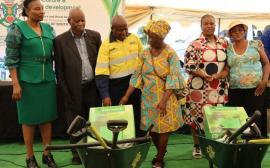
Women in Kabe Village, outside Mahikeng in the North West, have long loved working the land, but a lack of resources often held them back.
Now, thanks to the donation of essential farming implements, they can grow enough food to feed their families and improve their livelihoods.
The North West Department of Agriculture and Rural Development has brought renewed hope to the village with the donation of agricultural tools aimed at empowering women to take charge of food production.
The initiative is expected to strengthen household food security, create livelihoods and restore dignity within the community.
“These tools will truly make a huge difference in our lives. We have always loved working the land, but the lack of resources often discouraged us. After today, everything feels different,” said beneficiary Keabetswe Methikga.
For Methikga and other women in Kabe Village, the tools represent far more than equipment; they signal a turning point toward dignity, food security and economic independence.
Methikga explained how the lack of proper tools previously made farming a daily struggle.
“Before this, we struggled to farm with very limited equipment. Some days we had to borrow, and on other days we could not plant at all. With these tools, we can finally work the land properly, grow enough food for our families, and even sell produce to support our children,” she said.
She added that the donated equipment will help address long-standing challenges, such as crop destruction.
“Even the birds that used to destroy our crops will no longer be a problem, because we now have nets to protect our gardens,” Methikga said, her voice filled with relief and hope.
Agriculture and Rural Development MEC Madoda Sambatha said equipping women with the means to cultivate their own food promotes self-reliance, resilience and sustainable farming practices that will benefit future generations.
“Beyond food production, these tools open opportunities for income generation and local economic growth,” Sambatha said.
The handover ceremony was led by Sambatha and attended by Social Development MEC Susanna Basetsana Dantjie, traditional leadership of Kabe, and members of the local community, who gathered to witness women being equipped to take charge of their livelihoods.
In his address, Sambatha emphasised that the initiative forms part of the department’s broader efforts to empower women and build sustainable food systems at community level.
“This intervention is about more than tools; it is about restoring hope, dignity, and self-reliance. When we support women in agriculture, we are directly supporting families, fighting poverty, and strengthening food security. These women are not just beneficiaries; they are producers and partners in the development of our province,” Sambatha said.
He added that hunger and poverty expose communities, especially women and children to numerous social ills.
“By supporting food production initiatives such as this one, we are helping to strengthen the social fabric of our society. We will continue working closely with the Department of Social Development to ensure that these women receive the necessary support to make their projects sustainable,” Sambatha said.
Traditional leadership also welcomed the intervention and pledged continued support.
Speaking on behalf of the Royal House, Kgosana Keesilwe Mokgosi said the initiative reflected meaningful cooperation between government and communities.
“As custodians of the land, we are pleased to see government working hand in hand with our people. When our women are empowered to produce food, the entire village benefits.
“We commit ourselves to supporting all beneficiaries, encouraging active participation, and ensuring that these tools are used for their intended purpose,” Mokgosi said.
The tool donation in Kabe marks another practical step by the provincial government to place women at the centre of agricultural development, not only as recipients of assistance, but as active drivers of food production, economic participation, and community resilience.
Sambatha said the initiative will be expanded to communities across all four districts of the province through ongoing rural development and food security programmes. – SAnews.gov.za


