


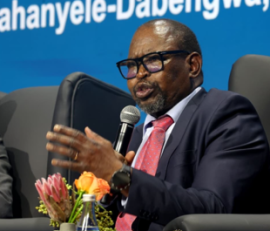
Finance Minister Enoch Godongwana says government’s decision to introduce a temporary R3 per litre fuel levy reduction is aimed at cushioning South Africans from what he describes as a significant economic shock driven by global oil price pressures.
The R3 per litre reduction in the fuel levy announced today, is aimed at lessening the impact of severe fuel price hikes, that come into effect tomorrow.
Speaking to the media on the sidelines of the South Africa Investment Conference (SAIC) on Tuesday, Godongwana said government had been closely monitoring rising tensions in the Middle East and their impact on global oil markets, which threatened to trigger steep fuel price hikes locally.
“We are aware that developments in the Middle East and their impact on oil prices are likely to affect our economy. We discussed different models and had to arrive at one that is affordable within the current fiscal environment,” the Minister said.
Government ultimately settled on a R3 per litre relief for petrol and diesel adjustment through a temporary reduction in the general fuel levy.
The intervention comes into effect from 1 April and will run for one month, significantly softening the expected fuel price increase, which was projected to exceed R5 per litre for petrol and climb even higher for diesel.
This as the price of all grades of petrol are set to rise by R3.06 a litre on Wednesday. The price of diesel will also rise by between R7.37 per litre and R7.51 per litre.
READ | Petrol, diesel prices announced
While motorists will still feel the increase, Godongwana said the relief ensures the impact is less severe.
“This is still for April. We are going to assess what to do in May and June,” he said, noting that the current intervention alone will cost the country around R6 billion in foregone revenue.
The Minister acknowledged that diesel prices remain a major concern due to their broader impact on the economy.
“The diesel sector powers the economy, and changes in diesel prices affect everything – food, fertiliser and transport costs,” he said.
To address this, the Minister said an interdepartmental team is exploring additional interventions beyond fiscal measures to mitigate knock-on effects across key sectors.
Despite the relief, Godongwana cautioned that government’s ability to sustain such measures is limited.
“This is a shock to the economy and a blow. Government can mitigate the effects for a specific period, but we cannot sustain it for longer without collapsing the tax system.”
He indicated that any continued relief would likely be limited to a maximum of three months, depending on global developments.
The Minister also stressed that South Africa is not alone in facing these pressures, as countries worldwide grapple with rising energy costs linked to geopolitical instability.
“If the war continues, a number of countries throughout the world are facing similar challenges,” he said.
On concerns about a potential recession, Godongwana said it was too early to raise alarm.
“Not at this stage,” he said, adding that inflation is expected to rise moderately by around 1.2 percentage points, remaining within the targeted range.
Government said the relief forms part of a broader, phased response that balances consumer protection with fiscal sustainability, with further support measures expected to be announced in the coming months. – SAnews.gov.za


