


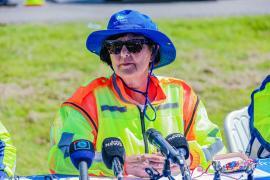
Government is making progress in reducing road accidents, with the latest preliminary data for the period 1 January to 15 March showing an 11% decline in crashes compared to the same period in 2025.
“Every province has seen a decrease in the number of crashes. Fatalities have decreased by 10% compared with the same period last year,” Minister of Transport Barbara Creecy said on Friday.
Six provinces recorded decreases in fatalities: namely Gauteng, Western Cape, KwaZulu-Natal, Mpumalanga, North West and Eastern Cape.
“This progress was not accidental; it is the direct result of coordinated law enforcement, strategic partnerships with civil society, and a shift in the collective consciousness of our road users. However, we cannot rest on these laurels. As long as one family still receives a knock on the door with news of a tragedy, our work is not done,” Creecy said.
She was addressing the launch of the 2026 Arrive Alive Easter Road Safety Campaign under the theme: 'It Begins With Me', on the N3, near Spruitview Offramp, East Rand.
The Easter holidays are marked by an increase in traffic on major corridors as travellers embark on various religious and holiday destinations.
Government has appealed to travellers to take personal accountability when using the roads during the upcoming holidays.
“Over 80% of road crashes are the direct result of human behaviour. We are calling on every driver, passenger, and pedestrian to take ownership of their conduct on our shared roads.
“Our law enforcement strategy over this time will be uncompromising. I have directed all agencies to prioritise public and freight transport safety as well as pedestrians,” the Minister said.
This year, there will be a targeted focus on preventing pedestrians from crossing and walking on highways.
“We will also patrol areas of entertainment near highways to prevent inebriated pedestrians from running across major roads. Pedestrians currently account for almost half of all road deaths.
“Traffic Authorities, for the first time this year, are instructed to deploy their students to patrol these national critical pedestrian locations and not release students to go home,” she said.
Law enforcement visibility in and around pedestrian accident-prone areas will be assisted by the members of the communities and support from the South African Police Service (SAPS).
“We continue our intensified focus on drunken driving. We are currently pursuing legislative amendments to Section 65 of the National Road Traffic Act to further tighten these restrictions.
“High-risk routes, including the N1, N2, N3, and N4, will see an unprecedented saturation of mobile and static checkpoints, as we intensify traffic policing on critical corridors together with the deployment of the National Traffic Police,” Creecy said.
In addition, in April, there is an increase in mobility across the region, with heightened movement of passengers and freight between South Africa and neighbouring countries.
“I call upon the Cross-Border Road Transport Agency to intensify monitoring and enforcement along key corridors to ensure full compliance with permit conditions, regulatory requirements, and overloading of freight and passengers.
“We will also prioritise vehicle roadworthiness and fatigue management, and clamp down decisively on illegal operations and non-compliance,” the Minister said.
She called on road users to use the roads responsibly and respect each other.
“I urge those who will be undertaking long-distance journeys to stagger your travel times to avoid peak congestion and to stop every two hours to combat fatigue. To the pedestrians: Be visible, and do not cross major highways while under the influence,” the Minister said. - SAnews.gov.za


