


South Africa has entered a decisive “year of action” for its youth, as government calls on young people, institutions, and society at large to unite under a bold national programme aimed at reshaping the country’s future.
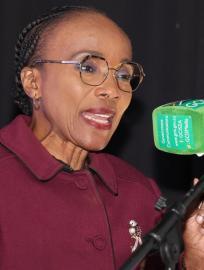
Delivering a keynote address at the Media launch of the Golden Jubilee commemoration of the 1976 youth uprising, held in Soweto, on Thursday, Minister in the Presidency responsible for Women, Youth and Persons with Disabilities (DWYPD) declared 2026 a turning point, anchored in the theme “RESET@50 – The Future Calls.”
The Minister said that just as young people organised in May 1976 toward a day of action, today’s generation must organise toward a year of national action.
“This is not just a campaign. It is a call to action: to remember truthfully, not through selective memory, but the full truth of pain, courage, betrayal, resilience and sacrifice,” the Minister said.
Democracy’s gains for young people
The Minister highlighted the significant strides made since 1994, when young South Africans first entered a system promising political freedom, equal citizenship and a renewed social contract.
The adoption of the Constitution in 1996, now marking its 30th anniversary, entrenched rights to dignity, equality and freedom, laying a foundation for expanded opportunities.
Chikunga noted that since then, the government has expanded access to education, student funding, youth development institutions, public participation platforms, skills development and employment pathways.
“Through generations of student activism and progressive deliberate policy choices of the democratic state, enrolment in the public university sector grew from 495 356 students in 1994 to 1 077 768 students in 2022. By 2025, public universities were projected to enrol over 1.15 million students, while TVET (Technical and Vocational Education and Training) colleges were projected to enrol over 587 000 students,” Chikunga said.
The Minister attributed sustained student activism, particularly the #FeesMustFall movement between 2015 and 2017, for accelerating progress toward accessible higher education.
She highlighted that through the National Student Financial Aid Scheme (NSFAS), nearly 3.9 million students benefited from R192 billion in funding between 2019 and 2023.
Government has also strengthened institutional support for youth development.
The National Youth Development Agency (NYDA), established through legislation in 2008 and recently amended in 2024, continues to play a central coordinating role.
In this financial year, government has allocated R1.8 billion to the NYDA to expand entrepreneurship, employment pathways and skills development, including support for youth-owned enterprises.
The Presidential Youth Employment Intervention has created a large-scale platform linking young people to opportunities, with more than 4.78 million young people registered on the National Pathway Management Network, and over 1.67 million earning opportunities secured by 2025.
The basic education sector has also contributed, with over 320 000 young people gaining work opportunities in approximately 23 000 public schools during the first phase of the Presidential Youth Employment Initiative.
“These gains matter. They show that democracy has created institutions, opened doors, and placed resources behind youth development. But the next phase must be measured by completion, transition, absorption, ownership and dignity,” Chikunga said.
Despite these achievements, the Minister cautioned that access alone is no longer enough. The next phase, she said, must focus on outcomes: completion of education, transition into work, economic participation, and dignity.
The Minister said the RESET@50 initiative calls for closer collaboration between higher education institutions, Sector Education and Training Authorities (SETAs), and industry.
She said universities and TVET colleges must work with industry to co-create curricula with employers to ensure graduates are equipped for real economic opportunities.
“To the private sector and strategic institutions, your presence must translate into concrete commitments [including] jobs and work experience, support for youth-owned enterprises, and investment in future skills.
Social, political and economic transformation
The Minister emphasised that RESET@50 is not only an economic intervention, but a broader societal transformation.
She said that a social reset is needed to rebuild cohesion and address challenges such as Gender-Based Violence and Femicide (GBVF), substance abuse, harmful masculinities, mental health challenges, racism, sexism, ableism, and social fragmentation.
A political reset must strengthen accountability and responsiveness, ensuring that the state listens, implements, and accounts to young people and society at large, while an economic reset must move young people from participation to ownership, and from access to real pathways.
“It must prepare young people for an economy already shaped by artificial intelligence, data, cybersecurity, digital platforms, e-commerce, green technologies, advanced manufacturing and new forms of work. We cannot allow the digital economy to become a new geography of exclusion,” the Minister said. – SAnews.gov.za


