


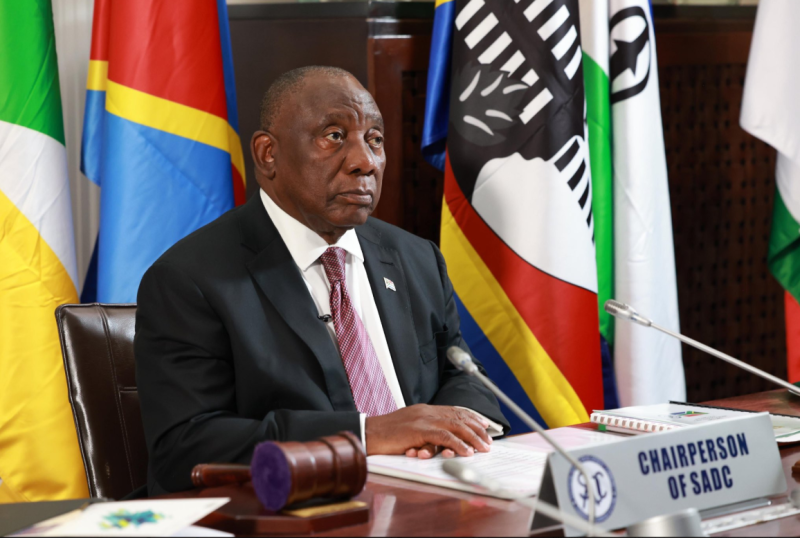
President Cyril Ramaphosa has called for stronger, more effective Southern African Development Community (SADC) institutions to accelerate regional integration, consolidate peace and stability, while improving the lives of people across the region.
Addressing the Virtual Extraordinary Summit of SADC Heads of State and Government on Wednesday, President Ramaphosa said the effectiveness of the regional organisation depended not only on the decisions it made, but also on its ability to implement them.
“We need an organisation that moves with greater urgency from agreements to implementation, from strategies to programmes, and from commitments to measurable results,” he said.
The Extraordinary Summit, held just over two months after the 46th Ordinary SADC Summit in Durban in August, was convened primarily to resolve outstanding leadership and institutional matters.
These include the appointment of the Deputy Executive Secretary responsible for Regional Integration and the election of the incoming Chairperson of the Organ on Politics, Defence and Security Cooperation.
President Ramaphosa said the leadership decisions were critical to strengthening SADC’s institutional capacity and advancing the Regional Indicative Strategic Development Plan 2020–2030 and the region’s longer-term Vision 2050.
He emphasised that regional integration must deliver tangible benefits to citizens through employment opportunities, improved transport and energy networks, greater food security, increased trade and expanded economic opportunities.
“Regional integration should be more than a mere aspiration expressed in declarations. It must become a reality for the people living in Southern Africa,” he said.
Peace and stability
The President said the election of the incoming Chairperson of the Organ on Politics, Defence and Security Cooperation was equally important, as peace, security and political stability underpin the region’s development and prosperity.
He highlighted the ongoing instability and humanitarian suffering in the eastern Democratic Republic of Congo (DRC), calling for continued regional cooperation to achieve a peaceful solution.
“We will continue to support the African Union and other regional and international partners to put an end to conflict and create the conditions for lasting peace.”
President Ramaphosa also called for continued support for inclusive dialogue, political stability and institutional reform in Madagascar, as well as a return to constitutional normality.
In Mozambique, he acknowledged ongoing efforts to promote peace, security and development, including measures to combat terrorism in Cabo Delgado.
“These examples show that peace does not come easily. Peace must be nurtured, institutions must be strengthened, and the legitimate aspirations of our people must be addressed,” he said.
He stressed the importance of upholding constitutionalism, democratic governance, the rule of law and the peaceful resolution of disputes.
Climate resilience, disaster preparedness
The President also highlighted the increasing frequency and severity of climate-related disasters as a major challenge facing Southern Africa.
He said droughts, floods, tropical cyclones and other extreme weather events continue to threaten communities, food supplies, shared infrastructure and economic activity across the region.
The severe El Niño-induced drought of 2023 and 2024 had exposed the region’s vulnerability to changing climatic conditions, with millions of people affected by food and water insecurity, declining agricultural production, livestock losses and disrupted livelihoods.
As the region approaches another agricultural season, developing El Niño conditions present further threats to food security, water supplies and economic activity.
He warned that recurrent flooding and cyclones could reverse development gains and place additional pressure on public finances.
He called for stronger regional disaster preparedness and response capabilities, improved early warning systems and increased investment in climate-resilient infrastructure.
The President also congratulated Mozambique’s President Daniel Francisco Chapo on organising the International Conference on Disaster Risk Reduction and Resilience in Africa, held in Maputo from 13 to 15 October 2026.
President Chapo was selected by the African Union as its Champion for Disaster Risk Management.
President Ramaphosa said the conference provided an opportunity to strengthen cooperation, mobilise investment and promote a more proactive approach to disaster risk management.
He called on SADC member states to build on the conference’s outcomes through greater cooperation in water management, agricultural resilience, disaster financing, infrastructure development and the protection of vulnerable communities.
“It requires us to recognise that our security is not only political and military. It is economic, environmental and human,” he said.
Delivering tangible results
President Ramaphosa said the challenges facing the region reinforce the need for capable and effective regional institutions that could provide leadership and practical solutions to shared problems.
He called on member states to preserve the solidarity, consensus and mutual respect that had characterised SADC throughout its history, while ensuring continuity and stability within its institutions.
“The true measure of our success will not be the number of resolutions we adopt, but the progress we make in improving the lives of the people of Southern Africa,” he said.
The President expressed confidence that member states would reach decisions that strengthened the organisation and served the interests of the people of the region. – SAnews.gov.za


