


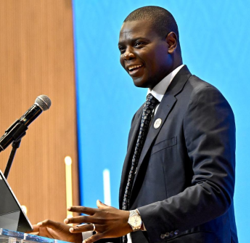
South Africa has assumed the Chairpersonship of the Southern African Development Community (SADC) Council of Ministers with a commitment to advance peace and security, accelerate regional industrialisation, strengthen infrastructure connectivity and invest in the region’s human capital.
International Relations and Cooperation Minister Ronald Lamola formally accepted the SADC Chairpersonship for 2026 – 2027 on behalf of South Africa during the SADC Council of Ministers meeting in Durban on Wednesday.
The Minister said South Africa accepted the responsibility with a clear understanding that the Chairpersonship was a collective mandate that must be exercised in the interests of the entire SADC Community.
“It is with great humility and a profound sense of responsibility that, on behalf of the Republic of South Africa, I accept the SADC Chairpersonship for 2026 – 2027.
“This is a collective responsibility that we must discharge in the interests of our community, guided by the principles of solidarity, unity, sovereign equality and shared prosperity,” Lamola said.
READ | SADC Executive Secretary highlights regional progress, challenges at Council of Ministers meeting
The Minister outlined four strategic priorities that will guide South Africa’s tenure under the leadership of President Cyril Ramaphosa. These include promoting peace, security and stability; accelerating industrialisation through agricultural transformation, critical minerals beneficiation and increased regional trade; expanding and modernising infrastructure, and strengthening social and human capital development.
Harnessing the region’s mineral wealth
Lamola said South Africa would place particular emphasis on ensuring that the region derives greater economic value from its abundant critical mineral resources.
“There is a growing consensus that rising demand for critical minerals presents a unique opportunity for our region’s economic and social development,” he said.
Nearly 30% of the world’s proven critical mineral reserves are found in the region, including approximately 50% of the world’s cobalt reserves and 20% of its graphite reserves.
However, Lamola cautioned that mineral wealth alone would not guarantee development, unless countries moved towards beneficiation, regional value chains and increased intra-regional trade.
“Yet, we know too well that this opportunity is not a foregone conclusion. We know from earlier chapters in our unfolding story that our region’s wealth has nourished economies far and wide, while our own economies have remained trapped in old patterns of extractive accumulation.
“Reversing this pattern requires us to beneficiate our resources, build regional value chains and trade more with one another,” Lamola said.
South Africa will also seek to advance the objectives agreed at the Skukuza retreat, including a target of 50 percent intra-SADC trade and the beneficiation of critical minerals at source.
Currently, trade between countries in the bloc stands at about 20%, highlighting the significant scope for expanding regional markets and economic cooperation.
Infrastructure key to regional industrialisation
Lamola said South Africa would also champion investment in infrastructure capable of connecting economies and supporting industrial development across the region.
He identified reliable energy, efficient transport corridors, modern ports, integrated digital networks and dependable water systems as essential foundations for regional connectivity and the movement of goods and services.
“Without these foundations, regional manufacturing cannot expand. At only 10% of GDP, it cannot generate employment on the scale our region requires,” he said.
The focus on industrialisation and infrastructure is closely linked to the region’s need to create employment opportunities, particularly for its growing young population.
Lamola noted that Africa has the youngest population in the world, with a median age of 19 years and nearly 60% of the population under the age of 25.
By 2030, he said, one in four young people globally would be African.
“This means our economies and level of job creation must be on par with population growth."
Migration requires regional solutions
The Minister also placed migration and human mobility firmly within the broader regional development agenda.
He acknowledged the growing public debate in South Africa around irregular migration, border integrity, access to economic opportunities, and pressure on public institutions and communities.
However, he stressed that responses to irregular migration must remain lawful and protect human rights.
“As we address the legitimate concerns of our citizens, we equally and forcefully reject all forms of vigilantism and human rights violations. Addressing the challenges associated with irregular migration must occur within an orderly and lawful framework."
Lamola said migration should not be viewed solely through a security lens, arguing that the movement of people across the region is often linked to economic opportunity and employment.
He pointed to Durban’s own history as evidence of the contribution of regional labour mobility to South Africa’s industrial development.
“Indeed, as Durban's story shows, our country's industrial development immensely benefited from the large labour pools from our region and beyond,” he said.
South Africa will, therefore, encourage SADC Member States to sign the protocol on the free movement of people to support regular and orderly migration.
“We are hopeful that, together, we can chart a path towards holistic and long-lasting solutions to the migration challenges facing our region. We call on countries within our bloc to sign the protocol on the free movement of people to enable regular and orderly migration,” Lamola said.
Building a peaceful and prosperous SADC
South Africa’s Chairpersonship, Lamola said, comes at a time of significant global uncertainty, marked by great power competition, climate-related disasters, the threat of pandemics and changing economic policies in advanced economies.
He said these developments reinforced the need for SADC countries to strengthen regional solidarity and build resilient economies.
“The people of our Community yearn for a region where they can thrive, where their countries trade with each other, where advanced infrastructure connects them to their neighbours and where jobs and economic opportunities are plentiful,” he said.
He said the Regional Indicative Strategic Development Plan 2020 – 2030 already provided the framework for achieving this vision. He, however, stressed that regional plans must translate into tangible improvements in people’s lives.
“Let us use this moment to renew our commitment to bridging the distance between the ambitions expressed in our regional instruments and the capacity of our institutions to realise them.”
Lamola further pledged that South Africa would use its position as the region’s most industrialised economy to support deeper regional integration and shared prosperity.
“As Southern Africa’s most industrialised economy, we recognise the duty and obligation to place our capabilities at the service of regional integration and shared prosperity. We approach the Chairpersonship in that spirit, with humility, purpose and a commitment to work with every Member State.”
Lamola also wished Zambia peaceful elections ahead of that country’s 13 August 2026 polls.
“Allow me to conclude by wishing Zambia to hold free and fair elections on the 13th of August 2026. Democracy remains the cornerstone of development. We wish the people of Zambia peaceful elections.”
South Africa’s assumption of the SADC Chairpersonship follows Zimbabwe’s tenure and will run until 2027. – SAnews.gov.za


