


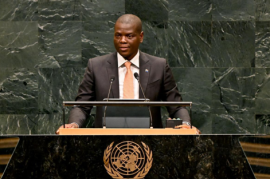
New York, USA - South Africa has called for stronger multilateral action to tackle global inequality, unsustainable debt and climate-finance constraints, warning that the international system risks losing public trust if it cannot demonstrate that cooperation delivers tangible improvements in people’s lives.
International Relations and Cooperation Minister Ronald Lamola said inequality, debt and underdevelopment were undermining both democracy and the promise of international cooperation.
“The promise of democracy and international cooperation wanes when we cannot demonstrate that they can address inequality and insecurity,” the Minister said.
Lamola was delivering South Africa’s National Statement during the General Debate of the 81st United Nations General Assembly in New York on Thursday. The debate is taking place under the theme “Restoring trust, managing transformation: A United Nations that delivers for all.”
Lamola placed inequality at the centre of South Africa’s development agenda, drawing on the country’s experience during its 2025 G20 Presidency.
He said the concentration of global wealth has reached levels that demand coordinated international action.
“Today, the top 10% own roughly 75% of global wealth, while the bottom 50% own only 2%. This extreme concentration of wealth at the top and poverty at the bottom is neither inevitable nor insurmountable,” he said.
South Africa, together with Brazil, Norway and Spain, is advancing the establishment of an International Panel on Inequality, building on the G20 work undertaken during South Africa’s Presidency. The proposal is intended to provide independent, science-based assessments of inequality and help policymakers respond to its causes and consequences.
“Together with Brazil, Norway and Spain, South Africa calls on this Assembly to throw its weight behind the establishment of an International Panel on Inequality,” Lamola said.
The four countries held a high-level event on the initiative on the margins of UNGA81 on 23 September, seeking support for the proposed panel and a future General Assembly resolution.
READ | Lamola: Global action needed to tackle inequality
Lamola linked economic inequality to growing social and political tensions.
He said citizens who had seen little improvement in their economic circumstances were increasingly turning towards ideas that run counter to the values of the UN Charter.
South Africa’s emphasis on inequality follows the G20 Global Inequality Report commissioned during its G20 Presidency. The report found that wealth inequality remains significantly higher than income inequality and recommended the creation of a permanent international body to assess and monitor global inequality.
SADC integration and industrialisation
Lamola also connected South Africa’s global agenda to its leadership of the Southern African Development Community (SADC).
“We approach our leadership of a regional bloc that is home to a quarter of Africa’s population – the SADC – with a firm resolve to champion greater regional integration, industrialisation and trade,” Lamola said.
He said stronger intra-regional trade would help Southern African economies share in regional prosperity while making them more resilient to external economic shocks.
“We want to increase trade among our countries so that our citizens can share in the prosperity of our region and our economies are better prepared to absorb the shocks of unilateralism,” he said.
He linked the regional experience to the wider multilateral system.
“If multilateralism works at regional level, then citizens have greater reason to believe it can work globally,” he said.
South Africa’s 2026 SADC Chairship has identified industrialisation, regional integration and infrastructure development among its priorities.
Debt
Lamola said developing countries were being forced to make difficult choices between servicing debt and investing in the needs of their populations.
He said African countries had spent roughly as much on debt servicing over the previous year as was needed to close the continent’s infrastructure financing gap.
“This grim reality inspired South Africa’s G20 Presidency to focus on debt sustainability,” he said.
Lamola also referred to the Africa Expert Panel report, which calls for greater debt transparency, closer scrutiny of credit-rating agencies and multilateral efforts to establish a Borrowers’ Club.
SDGs
Lamola warned that the international community was falling behind on the Sustainable Development Goals (SDGs).
“With only 36% of the Sustainable Development Goals showing sufficient progress, we are running out of time,” he said.
He called for multilateral action to free resources currently absorbed by debt servicing and redirect them towards development.
“Africa and much of the Global South need multilateral action to free resources absorbed by debt service and redirect them towards development.
“We must close the financing gap for the 2030 Agenda and meaningfully advance implementation of the African Union’s Agenda 2063,” he said.
The UN has identified accelerated SDG implementation and development financing as central priorities of the current General Assembly session.
Climate finance and the just transition
Climate change, Lamola said, was compounding existing development challenges as they threaten people, prosperity and development gains countries have made.
He said two million people in SADC had suffered the combined effects of floods, cyclones, wildfires and disease outbreaks over the past year.
“Our responses are severely constrained by a climate finance architecture stacked against developing nations,” the Minister said while also calling for stronger international action on disaster resilience and predictable financing for a just energy transition.
Climate action and the just transition are among the high-level priorities of UNGA81, with the UN convening a dedicated high-level event on climate action during the General Assembly’s High-Level Week.
Africa's critical minerals and AI opportunity
Lamola said Africa’s mineral wealth and youthful population could help reshape the continent’s role in the global economy.
“Our continent has the world’s largest reserves of critical minerals. These critical minerals can help bridge the gap between wealthy and poor nations and overcome the indignities of poverty and underdevelopment,” Lamola said.
He said Africa should not merely supply raw materials to global markets but should participate in beneficiation and value creation.
“We have a youthful population ready to play a key role in the beneficiation at source of critical minerals and on research and innovation for artificial intelligence (AI),” he said.
South Africa has placed critical-minerals beneficiation and industrialisation among its economic priorities, including through its SADC Chairship.
Lamola also called for stronger African participation in shaping the governance of AI.
The call aligns with South Africa’s broader UNGA81 position that global governance frameworks should ensure developing countries have meaningful participation in shaping emerging technologies.
GBVF and security
Lamola also highlighted South Africa’s response to gender-based violence and femicide (GBVF), noting that government classified GBVF as a national disaster in November 2025.
He said the decision recognised the need for exceptional measures to address the scourge.
The reference places human security alongside economic development in South Africa’s broader conception of what international cooperation should deliver.
Restoring trust through development
For South Africa, Lamola's statement linked economic justice directly to the credibility of the multilateral system.
The central message was that restoring trust cannot be achieved through institutional reform alone but also requires international cooperation to address the material challenges confronting developing countries, from debt and climate finance to inequality, infrastructure financing, industrialisation and technological transformation.
The International Panel on Inequality initiative is one of the clearest examples of South Africa seeking to carry a domestic and G20 priority into the UN system, while its SADC agenda seeks to demonstrate the value of regional integration.
Taken together, Lamola's economic and development priorities place inequality, debt sustainability, SDG financing, climate justice, critical minerals and AI governance at the centre of South Africa's call for a multilateral system that delivers more effectively for developing countries. – SAnews.gov.za


