


By Dikeledi Molobela
New York, USA — South Africa remains committed to strengthening its relationship with the United States through mutually beneficial trade, investment and cooperation, International Relations and Cooperation Minister Ronald Lamola said while affirming Pretoria’s domestic policies and its non-aligned foreign policy.
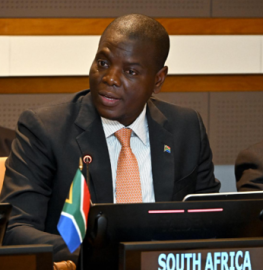
Lamola was speaking on Wednesday during an on-the-record discussion hosted by the Council on Foreign Relations on the sidelines of the 81st United Nations General Assembly. The Minister addressed questions on the state of South Africa-US relations, trade, critical minerals, the African Growth and Opportunity Act (AGOA), the G20, BRICS and reform of the United Nations Security Council.
The discussion comes against the backdrop of current developments in South Africa-US relations, including disagreements over South Africa’s domestic legislation and foreign policy positions.
Lamola said South Africa remained a constitutional democracy with functioning institutions and a commitment to building a united society.
“South Africa is a democracy with institutions that are working and functioning, [including] all three arms of the State: the executive, the judiciary and the legislature."
He said South Africa’s constitutional democracy was founded on the principle of unity in diversity.
“We have worked very hard as a country to preserve our unity in diversity, where all colours can live together - black, white, Indian and every person who finds themselves within the constitutional parameters of our country,” Lamola said.
Responding to questions about allegations concerning the treatment of white South Africans, Lamola rejected claims of genocide against Afrikaners and said the allegations were not supported by evidence.
“It becomes very unfortunate for us to be accused of any form of genocide against white Afrikaners of South African origin.
“What we can say to the people of the United States is that the story of white genocide does not exist, it’s fake news, it is not there. There is no evidence to back it up either through any form of technology,” the Minister said.
Lamola said the United States remained an important strategic partner for South Africa, pointing to the presence of American companies operating in the country and across the continent.
“As a country, we see the US as an important strategic partner.”
Trade and critical minerals
Lamola said economic ties offer an important platform for strengthening the bilateral relationship, particularly through trade, investment and the beneficiation of critical minerals.
South Africa is the largest US trade partner in Africa, according to US government data, while hundreds of US companies operate in the country.
Lamola said American companies have continued operating in South Africa, despite concerns raised about legislation such as Black Economic Empowerment (BEE).
“They are making money. They have never complained about BEE (sic),” the Minister said.
He said South Africa is seeking to deepen cooperation with the United States in areas including critical minerals, arguing that the country’s mineral resources and existing industrial base offer opportunities for both countries.
“We have said that it will be mutually beneficial, and the key aspect of it will be in the critical minerals beneficiation in our economy.”
South Africa’s 2025 G20 Presidency placed critical minerals among its priorities, with the G20 Leaders’ Declaration supporting greater value addition and beneficiation in mineral-producing developing countries, rather than simply exporting raw materials.
Lamola said South Africa’s mineral endowment provides a potential basis for deeper economic cooperation. The country enjoys a substantial concentration of critical minerals including platinum, rhodium and palladium, among others.
“We have almost the majority of them, and you already have an industrial base that can be leveraged by the South African government, the South African private sector, and the American government and the American private sector,” he said.
He said South Africa’s approach is to pursue agreements that are fair, transparent and consistent with its constitutional framework.
“We have said we are a non-aligned country. We are a constitutional democracy, so any trade agreement must also be transparent and fair. We don’t have a problem but it must be open for the public to see,” he said.
AGOA remains important
Lamola also welcomed the US Congress passing legislation that extends AGOA. However, he noted that South Africa remains concerned about the next steps.
The African Growth and Opportunity Act provides eligible sub-Saharan African countries with preferential access to the US market. AGOA’s duty-free trade benefits are thus extended through 31 December 2026, following its expiration in September 2025.
“With regards to AGOA, we want to thank Congress for having passed it through, with an understanding that we can all work together in a mutually beneficial way, also in beneficiation, which is a key aspect from our side,” he said.
Lamola said local manufacturing and value addition are important to ensuring that trade translates into jobs and broader economic benefits.
“It is a key programme, and we look forward to President Trump signing it.”
Asked whether South Africa is concerned about the future of the programme, Lamola said uncertainty remains until the process is complete.
“Yes, we are concerned because President Trump still has to sign the reauthorisation. We don’t know what will happen.
“We are glad that Congress has passed it through and we are hopeful that President Trump will sign,” Lamola said.
Taking Africa's voice into global forums
Lamola said South Africa’s approach to international economic diplomacy is also informed by its belief that African countries could strengthen their negotiating position by acting collectively.
He pointed to South Africa’s G20 Presidency as an example, saying Pretoria had deliberately sought to ensure that the continent’s priorities were reflected in the group’s work.
He said that South Africa invited several major African economies, including Nigeria, Algeria, Egypt, Ethiopia and Angola, to participate in its G20 engagements.
“When we hosted the G20, we saw it as an Africa G20. We took collective positions with the African Union, and we also brought and invited Africa’s big economies to participate with us, so that we could bring to bear or to reinforce Africa’s collective voice in the G20,” he said.
Lamola pointed to the G20’s work on critical minerals, artificial intelligence and climate finance as examples of areas where South Africa sought to advance African and Global South interests.
He said South Africa continues to advocate for a collective African voice in international forums.
South Africa's position on G20
Lamola also addressed South Africa’s position regarding participation in the next G20 process, saying Pretoria regards itself as a founding member and remains ready to participate if invited.
“… We are a founding member of the G20 and by right, we have to be there,” he said.
Lamola said South Africa had raised the matter with G20 members during bilateral engagements.
“When we engage with them, we remind them that we are full members of the G20, and we stand ready to come to the G20 if an invite is extended.”
Lamola said South Africa will not seek to force its participation or encourage a boycott.
“What we will not do is to… come uninvited. We will also not encourage a boycott of some sort.”
He said the question of South Africa’s participation is ultimately one for other G20 members to consider.
“We have said we are available. We will take the first flight out of Johannesburg if the invite is extended.”
BRICS as a Global South platform
On BRICS, Lamola said South Africa views the grouping as an important platform for the Global South, rather than an instrument for advancing South Africa’s interests alone.
“We don’t see it just for ourselves. While we have to maintain our own national interests and we want them to grow, [the platform] is an important voice of the Global South.”
He said South Africa supports the participation of more African countries in BRICS, pointing to its support for the inclusion of Egypt, Ethiopia and Nigeria.
“You will remember that it is South Africa that supported Ethiopia and Egypt joining BRICS, including Nigeria.”
Lamola said expanding African participation in BRICS could strengthen the continent’s collective voice on issues affecting the Global South.
“We think they must come in to serve the interest of the Global South and to build that voice that is necessary on the issues that we have already spoken about, including the reform of the UN Security Council.”
Multilateralism and African institutions
Responding to questions about whether the UN remains relevant amid growing geopolitical fragmentation, Lamola defended the role of multilateral institutions, while acknowledging the need for reform.
“We have to have a clear contrast to unilateralism and multilateralism. For us, [affirming] the existence of the UN, is an important step in affirming the supremacy of the United Nations and multilateral institutions in resolving global disputes.”
The UN, Lamola said, has not always operated according to expectations. He argued that this is a reason to reform and strengthen the system rather than abandon it.
“We need to do our best to ensure that we return to that level of working, and that level will be to follow the reforms, as outlined in the Pact of the Future, which clearly outlines how the UN Security Council can be reformed to find its relevance again.”
Lamola also pointed to South Africa’s contribution to African peace efforts. He cited South Africa’s support for efforts to strengthen African peacekeeping capacity. He welcomed the UN’s move to provide financing and reimbursement for African-led peace operations.
The Minister’s remarks formed part of a wide-ranging discussion in New York, which placed South Africa’s bilateral relationship with the United States within the broader context of its approach to multilateralism, African integration and Global South cooperation.
Lamola said South Africa will continue pursuing engagement with the United States, while maintaining its non-aligned foreign policy and advocating for reforms to global institutions.
For Pretoria, he said, the objective remains utilising South Africa’s economic position, its relationships across the Global South and its role in multilateral institutions to advance cooperation, while protecting the country’s national interests. – SAnews.gov.za


