


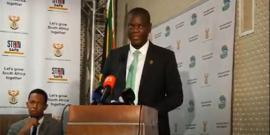
By Ronald Lamola, the Minister of International Relations and Cooperation
This year, South Africa commemorates two defining milestones in our democratic journey: the 50th anniversary of the Soweto Uprising of 16 June 1976 and the 30th anniversary of the adoption of the Constitution.
Both milestones remind us that democracy is neither inevitable nor self-sustaining: it is built through sacrifice, protected through active citizenship and strengthened through each generation’s commitment to freedom, justice and equality.
On 16 June 1976, young people took to the streets to peacefully protest against the imposition of Afrikaans as a medium of instruction. Despite the brute violence with which the apartheid security forces responded, the courage of the young people of 1976 awakened the conscience of the world and reinvigorated the struggle against apartheid.
The sacrifices of the youth of 1976 contributed immensely to the broader movement for freedom, justice and equality. They demonstrated that young people are not merely beneficiaries of change but are often its most powerful drivers. This year marks the Golden Jubilee of that historic moment.
Importantly, this commemoration is not only about remembering the past. It is about connecting the aspirations of 1976 to the realities of 2026.
The youth of 1976 fought for equal access to education and human dignity. The challenge today is to ensure that young people have meaningful access to economic opportunities, quality education, skills development, entrepreneurship and participation in society.
This year’s focus, “Mapping the Barriers: Auditing Access for Economic Inclusion”, calls on all sectors of society to identify and remove the obstacles that continue to prevent young people from realising their full potential.
The greatest tribute we can pay to the class of 1976 is not simply to honour their memory. It is to ensure that today’s generation is empowered to lead, innovate and thrive in a rapidly changing world.
One of the most important discussions taking place globally today concerns the role of young people in peacebuilding, governance and diplomacy. The adoption of United Nations Security Council Resolution 2250 on Youth, Peace and Security was a watershed moment in international policy.
It recognised that young people are not merely victims of conflict or passive observers of political processes. They are partners in peacebuilding, governance and sustainable development.
Africa is the youngest continent in the world. By 2050, nearly one in four people globally will be African. This demographic reality presents a tremendous opportunity.
If properly empowered, Africa’s youth can drive economic growth, innovation, democratic participation and peacebuilding across the continent. If excluded, however, the consequences will be felt across every sector of society.
South Africa has made important progress through the National Youth Policy and a range of youth development initiatives. However, there is growing recognition that we must continue strengthening the institutionalisation of youth participation across governance, peacebuilding and development processes.
Just as South Africa has developed a National Action Plan on Women, Peace and Security, there are important lessons to be learned from countries such as Finland and several other states that have developed dedicated Youth, Peace and Security National Action Plans. Such initiatives help ensure that youth participation is not ad hoc, but systematic, meaningful and sustained.
The 50th anniversary of 16 June 1976 coincides fittingly with the 30th anniversary of the adoption of the Constitution. Adopted on 10 December 1996, entering into force on 04 February 1997, the Constitution stands as the cornerstone of our democratic order. It is the product of decades of struggle against oppression and injustice. It reflects the aspirations of a people determined to build a society founded on human dignity, equality, freedom and the rule of law.
For thirty years, the Constitution has guided South Africa’s democratic development. It has provided the framework for democratic governance, constitutional accountability, social transformation and the protection of human rights.
Over the past three decades, South Africa has established robust democratic institutions, conducted free and fair elections, expanded access to education and healthcare, strengthened constitutional governance and advanced the rights of millions who were historically excluded.
Yet, we must also acknowledge that the work of transformation remains unfinished. Persistent inequality, unemployment, poverty, corruption and social exclusion continue to challenge our democratic project.
We mark these two important anniversaries during a time when the world is experiencing increasing strategic competition, technological disruption, economic uncertainty and growing pressure on multilateral institutions.
Competition over strategic resources, critical minerals, artificial intelligence, technological innovation and global supply chains is reshaping international relations. In this environment, diplomacy has become more important than ever
As the previous Chair of the G20, South Africa consistently advocated for more representative, equitable and inclusive global governance institutions.
The increasingly complex nature of international relations also requires broader societal participation in foreign policy discussions. It was precisely this recognition that informed the revival of the South African Council on International Relations (SACOIR).
The revival of SACOIR reflects the understanding that diplomacy and foreign policy benefit from diverse perspectives and informed public engagement. SACOIR will provide a platform for dialogue and debate involving government, academia, business, civil society and foreign policy practitioners.
South Africa’s foreign policy continues to be guided by the pursuit of peace, development, multilateralism, solidarity and a rules-based international order. – SAnews.gov.za


