


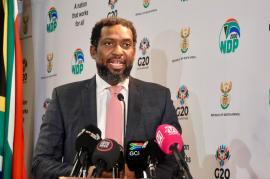
As South Africa commemorates the 50th anniversary of the Soweto Uprising on Tuesday, 16 June 2026, Minister of Higher Education and Training Buti Manamela says the task ahead is clear: to create opportunities for the country’s youth through education, skills development and pathways into employment.
“For millions of young people, access to education and skills development represents a pathway to dignity, economic participation and a better future. That understanding has strengthened my resolve to ensure that our institutions are responsive, accountable and focused on delivering opportunities,” he said in an interview with SAnews.
South Africa commemorates Youth Month and Youth Day in June to remember and honour the role young people have played in the fight against apartheid. The Soweto Uprising of 1976 was a turning point in the struggle for liberation.
Marked annually on 16 June, Youth Day commemorates a day on which thousands of courageous students stood together to march against oppressive apartheid education policies.
The activism demonstrated by the youth of yesteryear is something the Minister identifies with.
“Having served as a youth activist and leader in a number of youth and student movements, I have travelled a journey from activism to leadership. I now find myself in a position where I can contribute directly to realising many of the aspirations we fought for as students and youth. That is a responsibility I take very seriously. The issues we raised then - access to education, equality, dignity, opportunity and social justice - remain central to the work I do today as Minister,” he explained.
Manamela has previously served as the Deputy President of the South African Students Congress (SASCO) and as President of the South African College Student Association (now known as the South African Technical Vocational Education and Training Student Association).
Prior to his appointment as Minister of Higher Education and Training Department (DHET) on 21 July 2025, Manamela was the Deputy Minister of the same department and has a deep appreciation for both the opportunities and challenges within the Post-School Education and Training (PSET) system.
He has used his time in office to engage extensively with students, lecturers, university leaders, Technical and Vocational Education and Training (TVET) college principals, organised labour, business leaders and communities across South Africa.
He describes his appointment as Minister as a great responsibility, reflecting of his time at the helm of the Ministry.
“My experience to date has also confirmed that we are at an important turning point. The country faces a pressing need to align education and training more closely with the demands of a changing economy.
“This is why we have placed significant emphasis on the skills revolution, the expansion of occupational qualifications, the strengthening of TVET colleges, the modernisation of our qualifications framework, and the introduction of a dual system of learning and earning that combines classroom learning with workplace experience. We cannot continue producing qualifications in isolation from the realities of the labour market,” he explained.
His comments come as Statistics South Africa’s (Stats SA) Quarterly Labour Force Survey (QLFS) for the first quarter of 2026 revealed that the number of unemployed youth (aged 15-34) increased by 181 000 to 4.7 million compared with the fourth quarter of 2025.
In addition, the number of employed youth decreased by 258 000 to 5.6 million.
“As a result, the youth unemployment rate increased by 2.0 percentage points to 45.8% in the first quarter of 2026,” Stats SA said of the household-based sample survey that collects data on the labour market activities of individuals aged 15 years and older.
Reforms
In the DHET Budget Vote tabled in May, the Minister announced that 24 new occupational qualifications were introduced at TVET colleges in January 2026.
Asked about progress made in the rollout of the qualifications, the Minister said the rollout forms part of a broader reform of the country’s PSET system.
“[It] is aimed at ensuring that our qualifications remain relevant, credible and responsive to the needs of a modern economy. The new qualifications are designed in close partnership with industry and focus on providing learners with practical, workplace-relevant skills that improve employability and support economic growth.
“They form part of government's broader objective of strengthening the link between education, training and the world of work. The rollout is supported by significant progress across the skills development system.
“To date, 948 occupational qualifications and part-qualifications have been registered on the National Qualifications Framework (NQF), creating a strong foundation for the expansion of occupationally directed learning pathways,” said the Minister.
The NQF stipulates standards for qualifications and part-qualifications.
In addition, the department is working with the Quality Council for Trades and Occupations (QCTO), the South African Qualifications Authority (SAQA), Sector Education and Training Authorities (SETAs), TVET colleges, employers and industry partners to ensure that the necessary quality assurance, curriculum support, workplace learning opportunities and funding arrangements are in place.
“The transition was necessitated by the need to modernise parts of the qualifications system that were no longer adequately responding to changing industry requirements and emerging economic opportunities,” he said.
Meanwhile, the DHET is expected to table the Turnaround Strategy for TVET colleges later this year, with the Minister saying that President Cyril Ramaphosa has given the department the skills revolution mandate.
“We are very clear that, to achieve the revolution, we have to put TVET colleges at the centre because of their centrality to economic growth and industrialisation. The strategy will be informed by consultations with colleges, industry and organised labour. It will address infrastructure, lecturer development, student support and workplace partnerships. We have started with workplace partnerships and are receiving positive feedback from industry. We will be intensifying these partnerships.”
Investing in higher education
Minister Manamela has previously highlighted that the country’s universities could not accommodate the large numbers of students applying for placement. On whether government is looking to increase the number of public universities in the future, Manamela said the State is continuously assessing future capacity needs across the sector, not just universities.
He explained that while universities remain important, the answer is not simply to provide more university places.
Currently, South Africa has 26 public universities.
“The answer is more pathways into skills, employment and economic participation.
“In our 2026 Budget Vote Speech, we emphasised both infrastructure expansion and digital transformation across the Post-School Education and Training sector. When we speak about expanding infrastructure, we are not referring only to building more lecture rooms, campuses and workshops. We are also investing in digital infrastructure that enables flexible learning opportunities, expands access to education and prepares students for a rapidly digitising economy.”
Honouring the past and moving SA forward
As South Africa prepares to commemorate Youth Day, with the national commemoration due to be held at the FNB Premium Parking (open field adjacent to the FNB Stadium) in Nasrec, City of Johannesburg, Manamela said the 50th anniversary of the June 16 uprising is a reminder of one of the most defining moments in the nation's history.
“The courage, sacrifice and determination of the young people of 1976 helped change the course of South Africa and laid the foundation for the democratic society we enjoy today. The 50th anniversary of June 16 is certainly a celebration. It is a celebration of the resilience of young people, the victories of our democracy and the progress we have made as a nation,” he explained.
In addition, over the past 30 years, South Africa has made significant strides in expanding access to education and training, with the doors of learning that were once closed to the majority having been opened to millions.
He added that today, more young people than ever before have access to universities, TVET colleges, Community Education and Training colleges, bursaries, student funding and skills development opportunities.
“At the same time, this anniversary is also a moment of reflection. While we have come a long way, we must honestly acknowledge that there is still much work to be done. Too many young people continue to face unemployment, poverty and inequality. Many still struggle to access opportunities that can enable them to participate meaningfully in the economy and society,” he explained.
On what keeps him up at night, the Minister said: “The four million South Africans who are functionally illiterate; the many young people who are not in education, employment or training; and the unemployed graduates who have left our system.”
Government is clearly working to smooth out the bumps and overcome the challenges in the higher education sector. -SAnews.gov.za


