


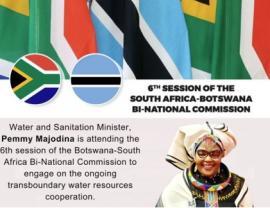
Minister of Water and Sanitation Pemmy Majodina and Botswana’s Minister of Water and Human Settlements Onneetse Ramogapi are expected to sign a Memorandum of Agreement (MoA) on the joint management of water quality and aquatic invasive species in the Upper Limpopo River Basin.
The agreement forms part of ongoing cooperation between South Africa and Botswana on the management of shared transboundary water resources.
Majodina is currently on a working visit to Gaborone for the 6th Session of the South Africa-Botswana Bi-National Commission (BNC), taking place on 20 and 21 May 2026.
The two countries enjoy strategic water cooperation on shared water resources in the Limpopo River Basin and are both members of the Limpopo Watercourse Commission (LimCom), established between South Africa, Botswana, Mozambique, and Zimbabwe to ensure the protection, ecosystem-based management, development and equitable utilisation of the shared river basin.
The Limpopo River Basin is a critical transboundary water resource that supports the livelihoods of a population of approximately 14 million people across the four nations through agriculture, domestic water supply, industry, biodiversity, and economic development.
The river transverses across the four countries, and as upstream members, South Africa and Botswana have a responsibility of ensuring that the quality of water in basin does not negatively impact the other countries.
The Upper Limpopo River Basin includes the Crocodile West, Marico, Mokolo, and Mogalakwena catchments in South Africa and the Notwane, Lotsane, Motloutse, Mahalapye, Tswapong, Bonwapitse, and Tuti Rivers in Botswana.
The Department of Water and Sanitation said Majodina will also participate in a ministerial meeting ahead of the BNC session, where discussions are expected to focus on the ongoing cooperation on transboundary water resources between the two countries and progress made on the joint feasibility study on Lesotho-Botswana Water Transfer (LBWT) project.
The LBWT project aims to supply water for domestic, agricultural and industrial usage by Botswana, Lesotho and South Africa through a 700 km water conveyance pipeline from a dam on the Makhaleng River, a tributary to the Orange-Senqu River in the lowerlands of Lesotho. – SAnews.gov.za


