


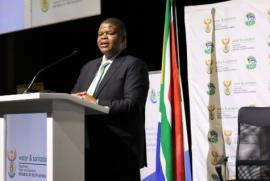
Water and Sanitation Deputy Minister David Mahlobo has called for stronger and more responsive regulation across Africa, warning that mounting environmental and economic pressures are straining the continent’s water systems.
Mahlobo was speaking at the 4th Africa Water Supply and Sanitation Regulators' Conference currently underway at the Cape Town International Convention Centre.
Delivering the opening address on Tuesday, Mahlobo warned that climate change, population growth and ageing infrastructure are placing increasing strain on the continent’s water systems.
He stressed that effective regulation is now “indispensable” to ensuring water security, economic development and public health.
The three-day conference, running from 19 - 21 May 2026, has brought together policymakers, regulators, and development partners from across Africa. It is convened by the Eastern and Southern Africa Water and Sanitation Regulators Association (ESAWAS).
Held under the theme, “Regulatory Requirements to Accelerate and Sustain Sector Progress”, the conference aims to address the enablers that need to be in place for regulators to catalyse continuous improvements in the access, quality and sustainability of services, while creating confidence in the sector for increased investment.
Mahlobo said the key question facing the continent is no longer whether water regulation is necessary, but whether existing systems are sufficiently capable, transformative, developmental and resilient to confront the realities of the 21st century.
“Those realities include intensifying climate change, rapid urbanisation, population growth, deteriorating infrastructure, growing inequality, financing constraints, rising energy costs, ecological degradation, and increasing competition over limited water resources,” he said.
He added that regulation must move beyond administrative compliance to become “an instrument of justice, sustainability, accountability and inclusive development”.
The Deputy Minister emphasised that in South Africa, access to water is enshrined as a fundamental human right under Section 27 of the Constitution, placing a clear obligation on the State to take reasonable legislative and other measures, within available resources, to progressively realise this right.
This constitutional obligation is further reinforced through the National Water Act of 1998 and the Water Services Act of 1997, both of which fundamentally transformed the governance philosophy of the water sector after apartheid.
At the centre of this framework, Mahlobo highlighted the principle of “water justice”, which seeks to ensure equitable access regardless of geography, race, income, class or historical privilege.
“It requires that rural communities, informal settlements, small towns, and historically disadvantaged populations enjoy the same dignity and developmental opportunities as affluent urban centres. Water justice further requires that regulation must balance economic sustainability with social equity,” Mahlobo said.
While water institutions must remain financially viable and operationally efficient, the Deputy Minister argued that no society can claim developmental progress when millions remain vulnerable to unreliable water supply, unsafe sanitation and infrastructure collapse.
South Africa, classified as a water-scarce country, faces growing pressure on its limited water resources. Average annual rainfall remains significantly below the global average, while demand for water continues to rise due to urbanisation, industrialisation, mining, agriculture, energy generation and the ongoing imperative to expand access to underserved communities.
Mahlobo said this reality means that effective regulation is essential to allocate water equitably, monitor performance, enforce compliance, protect consumers, improve efficiency, reduce non-revenue water, strengthen financial sustainability, and create certainty for long-term infrastructure investment.
“Importantly, regulation also creates the conditions necessary for public trust. Communities must have confidence that water institutions are transparent, accountable, and capable of delivering services consistently and sustainably,” the Deputy Minister said.
Across Africa, Mahlobo acknowledged persistent challenges, including ageing infrastructure, limited financing, weak municipal capacity, high levels of non-revenue water, pollution, rapid urbanisation and climate vulnerability.
However, he said these challenges also present opportunities to modernise infrastructure, adopt new technologies and strengthen regional cooperation.
“Africa cannot achieve Agenda 2063, the Sustainable Development Goals (SDGs) or meaningful industrial development without securing sustainable water and sanitation systems. Water is not peripheral to development. Water is development,” the Deputy Minister said. – SAnews.gov.za


