


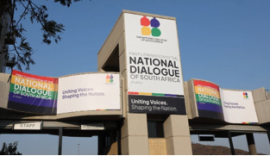
The National Dialogue Steering Committee has formally adopted a framework that will guide the rollout phase of the National Dialogue pilot process.
Steering Committee spokesperson Qhamisa Tengile said this follows the adoption of the National Dialogue Roadmap in March, which “laid the strategic foundation for the phased national rollout of the National Dialogue process”.
“The adoption of the Implementation Framework marks an important transition from strategic planning toward structured pilot implementation, as the National Dialogue continues to build the governance, operational and participation architecture required to support a credible, inclusive and citizen-led national process owned by the people of South Africa.
“The adopted Implementation Framework provides a coordinated operational pathway for the pilot phase scheduled to commence in June 2026 and conclude in August 2026. During this phase, the thirty-nine (39) sectors of the National Dialogue will coordinate a total of 195 pilot dialogues, including ward-based, digital, media-based and sectoral dialogues across all nine provinces of South Africa,” Tengile said.
The pilot phase is designed as a deliberate national learning and participation process aimed at:
- Testing methodologies and engagement models;
- Strengthening systems and operational readiness;
- Ensuring broader accessibility and inclusion;
- Integrating existing grassroots and community dialogues, and
- Enabling citizens and communities themselves to shape the future implementation methodology of the National Dialogue.
“The Steering Committee emphasises that the Implementation Framework remains a working operational guide that will continue to evolve through implementation learning processes, sectoral coordination and ongoing institutional refinement.
“In this regard, the National Dialogue seeks to proceed with both urgency and responsibility, recognising the importance of ensuring that the process remains grounded, inclusive, credible and responsive to the lived realities of South Africans.
“The implementation phase is guided by the principle that the National Dialogue must not merely speak about communities, but must create meaningful platforms through which communities are able to speak for themselves, influence national reflection and contribute towards a people’s compact aimed at informing the future growth trajectory of the Republic of South Africa,” she said.
The proposed pilot dialogues are expected to prioritise:
- Balanced participation across provinces, districts, rural communities, urban centres, townships and sector formations;
- Direct community participation and ward-level engagement, targeted at approximately 60% of the rollout;
- Building trust through direct engagement in communities often excluded from national processes;
- Multilingual facilitation approaches;
- Trauma-informed engagement methodologies, and
- Dialogue models capable of navigating South Africa’s social, economic and geographic diversity.
“The Steering Committee further recognises that the success of the National Dialogue depends not only on engagement itself, but also on the strength of the systems supporting implementation, coordination and rapid response capacity,” Tengile added.
She noted that due to the upcoming Local Government Elections scheduled for November this year, the dialogue will take a pause.
“In recognition of the heightened political environment during the election period, and in order to preserve the non-partisan credibility, neutrality and integrity of the National Dialogue process, the Steering Committee has resolved that the Dialogue will enter a pause and reflection period between September and December 2026,” she said.
The spokesperson emphasised that the National Dialogue remains committed to “advancing a shared national vision rooted in accountability, social justice, democratic participation and ethical leadership”.
“The National Dialogue remains fully committed to constitutional values, democratic participation, accountability, dignity and social cohesion. The process further places particular emphasis on ensuring that communities historically excluded from formal policy and decision-making spaces are meaningfully included within the national conversation.
“The Steering Committee therefore calls upon all sectors of society, including communities, civil society organisations, organised labour, business, youth formations, academia, faith-based institutions and broader social partners, to actively participate in shaping a credible, solutions-oriented and citizen-led National Dialogue process for the future of South Africa,” Tengile said. – SAnews.gov.za


