


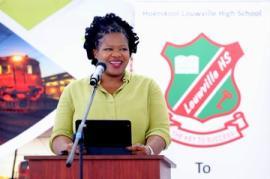
Learners at Louwville High School in Vredenburg on the West Coast of the Western Cape are stepping into a more connected future, following the handover of a Mobile Digital Library by Deputy Minister in the Presidency, Nonceba Mhlauli.
The handover forms part of ongoing efforts to expand access to digital learning resources, enhance teaching and learning outcomes, and promote digital inclusion, particularly in schools with limited connectivity and infrastructure.
“As a government, we remain committed to building a capable, inclusive, and digitally enabled society. Initiatives such as this one are aligned with our broader vision of ensuring that no young person is left behind in the digital age. Through this Mobile Digital Library, we take a meaningful step toward ensuring that the right to education and access to information are realised in practice.
“Because when we invest in young people, we invest in the future of our economy, our democracy, and our nation,” Mhlauli said on Tuesday.
The Mobile Digital Library provides learners and educators with access to curriculum-aligned content through offline digital platforms, enabling interactive and technology-enabled education.
“This year also marks 30 years of our democratic Constitution, a living document that enshrines the rights to education, access to information, and human dignity. Today, we give practical expression to those rights.
“Because access to education, access to information, and access to opportunity are not abstract ideals. They are fundamental human rights. And in today’s world, those rights are deeply connected to digital access,” she said.
She expressed concern that South Africa continues to grapple with deep inequalities, especially within the education system.
“Too many of our young people, particularly in underserved communities, remain excluded from the digital world that increasingly defines success in the 21st century. This Mobile Digital Library is a direct intervention in that reality.
“It says to every learner here that you matter. Your potential matters. And your access to the tools of the future matters. Because in today’s world, digital access is no longer a luxury. It is a necessity. It is the foundation upon which education, innovation, and economic participation are built,” the Deputy Minister added.
She encouraged the learners at the school to explore subjects beyond textbooks, learn new skills and discover new careers.
“Teach yourselves to code, to research, to think critically, and to innovate. Because the future economy will reward those who create, who solve problems, and who lead.
“To the teachers and the broader community. Support learners in navigating this digital space responsibly and productively.
“To parents and community members, protect it, support it, and take pride in it. This is a shared asset, and its success belongs to all of you,” Mhlauli said.
She stressed the importance of the government, communities and the private sector working together with a shared purpose.
“I would like to commend our partners Kumba Iron Ore, Transnet, and RuraTech for their commitment to investing in young people and in the future of this country.
“This is what meaningful partnership looks like. It is not only about corporate social responsibility. It is about co-creating solutions that have a lasting impact. When we align resources, expertise, and intent, we move faster and we move further,” Mhlauli said. -SAnews.gov.za


