


Public employment programmes must not entrench dependency, but create pathways to skills, work experience, and long-term opportunities.
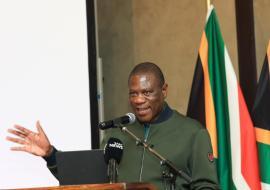
This was a message delivered by Deputy President Paul Mashatile at the 2026 Annual Labour School held at Kevits Kroon in Pretoria on Sunday.
Addressing delegates, the Deputy President said South Africa stands at a “decisive moment” in its democratic journey, where policy choices and collective action will shape the country’s economic and social future.
He called on organised labour and broader society to return to the foundational principles of the liberation struggle, anchored in three enduring pillars, including mobilisation, education, and unity.
“These pillars must guide us as we confront the defining challenges of our time [including] global economic instability, widening inequality, and the disruptive impact of technological change,” the Deputy President said.
Mashatile traced the roots of labour activism to historic milestones such as the 1973 Durban strikes, when mass strikes revived Black unionism and the fire that forced recognition of Black unions in 1979, and the formation of Congress of South African Trade Unions (COSATU) in 1985, which played a pivotal role in undermining apartheid.
He also acknowledged the contributions of other labour formations, including the National Council of Trade Unions, the Federation of Unions of South Africa, and the more recent South African Federation of Trade Unions (SAFTU), which emerged to continue the fight against job losses, inequality, and poverty.
The Deputy President warned that unemployment, particularly among young people, alongside deepening inequality and persistent poverty, continue to scar our nation.
“These challenges must never be normalised,” he said, calling for a unified response bringing together workers, unions, communities, government, and society at large.
Mashatile outlined the priorities of the 7th Administration, which include driving inclusive growth and job creation, reducing poverty and the cost of living, and building a capable, ethical, and developmental state.
He noted that the 2026/27 Budget continues to prioritise social protection, with the social wage accounting for more than 60% of non-interest spending. At the same time, he said, government is expanding employment opportunities through infrastructure investment and the Presidential Employment Stimulus, particularly targeting young people and women.
Structural reforms under Operation Vulindlela are also addressing constraints in energy and logistics, laying the foundation for sustained, inclusive growth.
While acknowledging that the economy grew by 1.1% in 2025, with inflation eased to 3.0% in February 2026, Mashatile warned that economic growth must translate into meaningful job creation.
“Growth without jobs is not enough. True progress is measured not in statistics, but in lives uplifted, dignity restored and hope renewed,” the Deputy President said.
He stressed that public employment programmes must be designed to build skills and create sustainable opportunities rather than fostering dependency.
“This is how a capable state acts, protecting the vulnerable today while building productive capacity for tomorrow.’
Mashatile said formal employment is shrinking while precarious work is on the rise, leaving many workers live with uncertainty.
He called for stronger protections against exploitation, expand access to secure employment, and enforce health and safety standards without compromise.
“No worker should lose their life or livelihood due to non-compliance,” he said.
Mashatile also urged trade unions to evolve beyond traditional wage negotiations to play a more active role in shaping macroeconomic policy, supporting labour-intensive investment, and driving skills development and job creation.
As Chair of the Human Resource Development Council, he reaffirmed the government’s commitment to aligning education and training with labour market needs.
Technology must empower workers, not replace them
The Deputy President highlighted the growing impact of artificial intelligence across sectors, such freight logistics at Transnet and energy, warning that technological change must not come at the expense of workers’ dignity.
“While these innovations improve efficiency, they also reshape jobs and demand new skills. Our responsibility is clear, no worker must be managed or dismissed by an algorithm alone; workers must share in productivity gains; displaced workers must be retrained and supported,” he said.
Mashatile also challenged labour federations to consider developing a Digital Workers’ Charter, grounded in the right to retraining; data sovereignty; digital dignity; human oversight in all automated systems.
On social challenges, he acknowledged the housing difficulties faced by many public servants who fall outside eligibility for subsidised housing but cannot afford mortgage finance. He noted that government is working on innovative housing solutions that ensure access to affordable, quality housing.
He emphasised the importance of strengthening social dialogue through platforms such as the National Economic Development and Labour Council (NEDLAC). – SAnews.gov.za


