


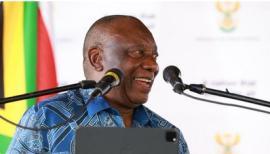
There was jubilation, song and dancing in uMzimkhulu on Friday as President Cyril Ramaphosa handed over title deeds to communities and families dispossessed of their land under colonial and apartheid rule.
Representatives of the Ngunjini, Ndzimankulu/Vierkant and St Paul communities, along with the Lawrence family, erupted into celebration as they took to the stage to receive their title deeds marking the end of a decades-long struggle to reclaim their ancestral land.
The ceremony formed part of government’s land restitution programme under the Restitution of Land Rights Act, which seeks to redress historical injustices caused by discriminatory land laws.
Addressing beneficiaries and dignitaries, President Ramaphosa described the occasion as both a celebration and a moment of profound historical significance.
“Today is a day for celebration. It is the culmination of a long journey,” the President said, acknowledging the resilience of communities who had waited years, in some cases generations, for justice.
He emphasised that the handover was about more than legal ownership.
“We are gathered not just to give you the title deeds to your ancestral land; we are here to restore the dignity and belonging that was taken from you through a great injustice and suffering,” he said.
President Ramaphosa located the dispossession within South Africa’s painful history, pointing to laws such as the Natives Land Act, which systematically stripped black South Africans of their land, livelihoods and identity.
Describing land dispossession as the “original sin” that continues to shape inequality, the President said the return of land must translate into meaningful economic change.
“Restored land must translate to sustainable development. It must be a vehicle for upliftment, for poverty alleviation and for job creation.
“We call on the Communal Property Associations to use the financial benefits from this land restitution to develop their communities and to ensure that this prosperity is shared by all,” he said.
The President said the handover of these title deeds on the eve of Human Rights Day reminds the nation that achieving our freedom was about far more than rights on paper.
“It was and remains about advancing human dignity and building an economy and society that benefits all,” he said.
In total, around 18 000 hectares of land has been restored to approximately 2 800 beneficiaries across the four claims, including more than 500 women-headed households.
The President said the restored land, much of which is used for commercial forestry, would continue to generate income for communities through existing lease agreements, helping to improve livelihoods while ensuring productivity is maintained.
He also called on the private sector to deepen partnerships with beneficiary communities, enabling them to participate meaningfully in economic value chains.
“By supporting this restitution journey, companies are investing in the dignity, livelihoods and future of communities. This restituted land will now benefit not just the original claimants but also their descendants for generations to come,” he said.
The handover comes as South Africa marks Human Rights Month and celebrates 30 years since the adoption of the Constitution, which enshrines the right to land restitution under Section 25 of the Bill of Rights.
President Ramaphosa said government has settled nearly 16 900 land claims in KwaZulu-Natal since 1994, with more than R376 million invested in the Harry Gwala District alone for land acquisition, compensation and development support.
While acknowledging frustrations around the pace of land reform, the President reaffirmed government’s commitment to accelerating the transfer of title deeds and expanding access to land.
“The title deeds being handed over today represent legal certainty, economic opportunity and generational security. When we return land, we return identity and heritage. Most importantly, we restore hope,” he said.
For the communities gathered in uMzimkhulu, that hope was expressed not only in words, but in song, dance and celebration as generations of struggle gave way to a renewed sense of ownership, dignity and possibility. – SAnews.gov.za


