


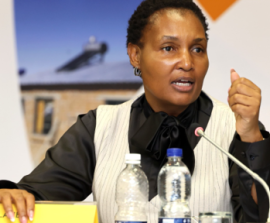
Approximately 3.4 million households have registered for government housing assistance, Human Settlements Minister Thembi Simelane told the National Council of Provinces (NCOP) on Tuesday.
Responding to questions for oral reply, Simelane said the figure is drawn from the National Housing Needs Register (NHNR) - the department’s official database of individuals and households seeking State housing support.
She noted that Census 2022, released by Statistics South Africa, does not provide a single official national housing backlog figure, but instead offers household and dwelling data used to derive estimates.
According to the census, South Africa had about 17.8 million households in 2022, with roughly 12% to 13% living in informal dwellings, including informal settlements and backyard structures.
“Using Census 2022 as the demographic base, national housing backlog estimates currently in use range between approximately 2.1 million housing units (Institute of Race Relations - Public Policy Estimates, 2025) and 2.2 million housing units (Centre for Affordable Housing Finance 2024/25).
“While Census 2022 does not state a backlog figure directly, the most recent, widely cited and sector accepted backlog estimate is between 2.1 and 2.4 million housing units, derived using Census 2022 household data as the baseline,” the Minister explained.
Simelane emphasised that while the department does not publish a single verified official “housing backlog” figure, the NHNR remains the most reliable indicator of demand for housing assistance.
On government interventions, she said in line with the Medium Term Development Plan for the 2024/25 to 2029/30 period, the department has planned to deliver 230 000 full subsidy units and 314 000 serviced sites over five years, with existing programmes, such as the Upgrading of Informal Settlements Programme, playing a key role.
Flood damage verification process underway
Simelane also confirmed that a verification process will be conducted to assess the impact and cost of recent flood damage in Limpopo, Mpumalanga, Gauteng, Eastern Cape and KwaZulu-Natal to determine the required interventions in those areas.
She said the process will determine the necessary interventions, including the provision of emergency fire kits in informal settlements, assessments by the National Home Builders Registration Council (NHBRC) for partially damaged homes, and Temporary Residential Units where properties are completely damaged.
“Once the project has been concluded, the department is able to confirm the expenditure base on the work done,” the Minister explained.
Simelane said all affected provinces have already conducted preliminary impact, and a cost analysis and impact on infrastructure as a motivation to apply for the Disaster Relief Fund. – SAnews.gov.za


