


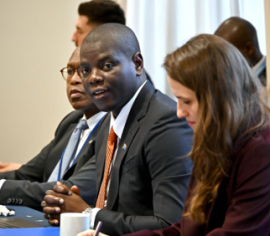
New York, USA —International Relations and Cooperation Minister Ronald Lamola says the international community has a duty to stop the suffering in Gaza, reaffirming South Africa’s decision to pursue its case against Israel at the International Court of Justice (ICJ).
Lamola said South Africa views its legal action under the Genocide Convention as part of its broader commitment to international law and the protection of civilians.
“Firstly, with regards to the Gaza matter, we see it as a moral imperative for the people of the world and for ourselves, given our history of apartheid.
“We see what is happening in Gaza as exactly what happened in South Africa during the apartheid period, and that’s why we felt we had a duty to approach the ICJ in terms of the Genocide Convention,” Lamola said.
The Minister was speaking during an on-the-record discussion hosted by the Council on Foreign Relations in New York on Wednesday on the sidelines of the 81st United Nations General Assembly.
SA's case before the ICJ
South Africa instituted proceedings against Israel at the ICJ in December 2023, alleging violations of obligations under the Genocide Convention in relation to Palestinians in the Gaza Strip.
The Court subsequently issued provisional measures in January, March and May 2024. The measures are binding on the parties, while the underlying case on the merits remains ongoing. In May 2026, the Court set procedural deadlines for further written pleadings, with South Africa’s Reply due in November 2027.
Lamola said South Africa remains committed to the case and to the wider principle that international law must be upheld.
“We think the world has a duty to stop it.”
South Africa submits further dossier
South Africa has continued to pursue the matter at the ICJ.
On 25 August 2026, the country submitted a substantial dossier of information to the Court concerning Israel’s implementation of the provisional measures. The Department of International Relations and Cooperation (DIRCO) said the submission was intended to assist the committee of judges monitoring the implementation of the measures.
Lamola said South Africa believes the Court’s orders needed to be respected.
“Unfortunately, with the three provisional measures, the state of Israel is still not respecting that injunction of the Court.”
South Africa has characterised the provisional measures as legally binding and has said Israel has not complied with the orders. Those are South Africa’s submissions to the Court; the underlying genocide case has not yet reached a final judgment on the merits.
Countries engage with the case
Lamola also pointed to international participation in the proceedings.
“We are glad that there is a number of countries that have now joined us in the ICJ, while others are withdrawing. But there is a huge number that has joined,” he said.
The status of interventions has continued to evolve. Most recently, the ICJ recorded Colombia’s withdrawal of its declaration of intervention in the proceedings, which it had filed in April 2024.
South Africa's position is that its pursuit of the case is grounded in its commitment to international law and the Genocide Convention.
Lamola's comments form part of a broader foreign policy position that South Africa has advanced throughout the 81st session of the United Nations General Assembly (UNGA81), that disputes should be addressed through multilateral institutions and international law.
In an address in New York earlier this week, Lamola said South Africa remains committed to defending the principles of the UN Charter and international law, describing the current pressure on multilateral institutions as part of a wider global crisis.
For Pretoria, the Gaza case therefore remains both a legal proceeding before the ICJ and an expression of its stated commitment to international law and multilateral institutions. – SAnews.gov.za


