


By Dikeledi Molobela
New York, USA — South Africa has called for concrete action and increased development financing to ensure that the Pact for the Future translates into meaningful opportunities for Africa’s young people and delivers measurable progress ahead of its 2028 review.
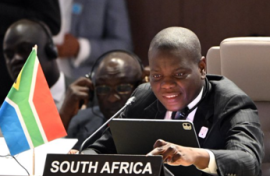
International Relations and Cooperation Minister Ronald Lamola said Africa’s youthful population presented an extraordinary opportunity for the continent and the global community but warned that the ambitions contained in the Pact could not be realised without adequate financing for development.
Lamola was speaking at a high-level side event on the implementation of the Pact for the Future in Africa, held on the margins of the 81st United Nations General Assembly in New York on Tuesday.
The event focused on translating the Pact’s commitments into concrete action on the continent, including youth empowerment and financing for development.
The Pact for the Future, adopted by UN Member States in 2024, provides a framework for advancing sustainable development and financing for development, international peace and security, science, technology and innovation and digital cooperation, youth and future generations, and global governance.
“As Chair of the Southern African Development Community, South Africa shares the belief that youth empowerment and financing for development are key priorities for our region and our continent.
“At its core, the Pact for the Future is an affirmation of our shared responsibility to future generations,” Lamola said.
He said this responsibility was inseparable from Africa’s young people, noting that the continent has the youngest population in the world, with a median age of 19 years.
“Our youthful population represents an extraordinary opportunity for our continent and the global community,” Lamola said.
He stressed that the commitments contained in the Pact must translate into tangible improvements in the lives of young Africans, including through quality education and skills development, access to decent work, entrepreneurship and meaningful participation in public life.
“For SADC, investing in youth is an investment in social cohesion, economic transformation and shared prosperity,” he said.
Financing remains critical
Lamola said the ambitions of the Pact, including its commitments to young people, could not be achieved without addressing the continent’s development financing needs.
“To achieve the SDGs by 2030, Africa needs to close an annual financing gap of 1.3 trillion US dollars,” he said.
Countries of the Global South are facing growing pressure on public finances, high borrowing costs and increasing climate-related financing needs, he said.
“These challenges directly affect our ability to invest in infrastructure, human capital and productive capacity,” he said.
Lamola said these pressures underscored the importance of the Pact’s call for reform of the global financial architecture.
South Africa’s G20 Presidency had called for greater debt transparency and accountability from credit rating agencies and supported the establishment of a Borrowers’ Club to strengthen the collective voice of indebted nations, he said.
“We attach special importance to the Seville Commitment and to ongoing efforts to strengthen international tax cooperation,” the Minister said.
He said negotiations towards a UN Framework Convention on International Tax Cooperation presented an important opportunity to strengthen domestic resource mobilisation and address challenges arising from the international tax system.
“The negotiations for a UN Framework Convention on International Tax Cooperation present a unique opportunity to support domestic resource mobilisation and address challenges arising from the international tax system,” he said.
Lamola said strengthening countries’ ability to mobilise resources for development was essential to delivering on the priorities contained in the Pact.
From commitments to measurable progress
Looking towards the 2028 review, Lamola said the focus must now shift towards implementation, with countries and institutions working together to ensure that commitments translate into measurable results.
“As we look towards 2028, our task is to ensure that implementation of the Pact is anchored in concrete action and measurable progress,” he said.
He said SADC remained committed to working with the African Union, the United Nations system, the UN Economic Commission for Africa, Member States and other partners to advance the continent’s priorities.
The implementation of the Pact is being advanced through engagement with Member States, the UN system, civil society and young people, with a particular focus on translating its commitments into practical action.
Lamola said the continent’s young population should be at the heart of these efforts.
“Let us ensure that the Pact for the Future becomes not only a framework of commitments, but a catalyst for unlocking opportunities for young people and future generations,” the Minister said.
He added that this would require sustained cooperation and a shared commitment to turning Africa’s demographic advantage into inclusive development, economic transformation and shared prosperity. – SAnews.gov.za


