


By Dikeledi Molobela
Government has taken a significant step to bolster national security and intelligence integration with the official launch of the National Centre for Intelligence Coordination (NCIC), a move aimed at enhancing the country’s ability to anticipate, detect and neutralise evolving threats.
Speaking at the official launch on Tuesday, Minister in the Presidency, Khumbudzo Ntshavheni, underscored the strategic importance of the new centre, positioning it as the nerve centre of South Africa’s intelligence architecture.
“Today is not a ceremonial indulgence. It is a reaffirmation of mandate, of law, and of responsibility,” the Minister said.
The NCIC, which functions as the Office of the Coordinator for Intelligence, is rooted in the National Strategic Intelligence Act 39 of 1994, specifically Section 4, which establishes the framework for intelligence coordination in the Republic in line with the Constitution.
“We gather under the authority of the National Strategic Intelligence Act 39 of 1994, specifically Section 4, which does not merely constitute a committee, but establishes the Republic’s central nervous system for intelligence coordination.
“NICOC is where the fragmented becomes unified, where information becomes insight, and where insight must become action,” Ntshavheni said.
A unified intelligence system
The Minister emphasised that the NCIC consolidates South Africa’s intelligence capabilities into a single, cohesive system, integrating domestic, foreign, defence and crime intelligence under a unified command structure.
“You are not parallel structures. You are one system, defined in law and bound in purpose,” she told members of the National Intelligence Co-ordinating Committee (NICOC).
She cautioned that coordination must be treated as a strategic imperative rather than an administrative process.
“Let me be clear, coordination is not a bureaucratic exercise. It is a strategic function. Where coordination fails, Threats are missed; Signals are ignored and the state is exposed.
“Conversely, where coordination succeeds, threats are pre-empted; resources are aligned and the Republic is secured without noise,” Minister Ntshavheni said.
Symbolism and duty
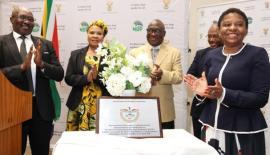
A key highlight of the launch was the unveiling of the NCIC emblem and the presentation of commemorative coins to NICOC members, symbols the Minister said carry deep institutional meaning and responsibility.
“The coins I present to you today, bearing the insignia of the National Centre for Intelligence Coordination (NCIC), (which is in all intents and purposes, the Office of the Coordinator for Intelligence), are not tokens. They are markers of duty,” she told members of the NICOC.
She explained that the coin’s design reflects the intelligence community’s mandate.
“Each element on this coin reflects the mandate you carry. The five stars represent you, the statutory members of NICOC, drawn from the core intelligence disciplines of the Republic - domestic intelligence, foreign intelligence, defence intelligence, crime intelligence, and the coordinating authority vested in the Office of the Coordinator,” she said.
At the centre of the emblem is the secretary bird, symbolising vigilance and decisive action.
“At the centre stands the secretary bird, not a passive observer, but a decisive hunter of threats. It does not merely watch. It identifies, engages, and neutralises. This is the standard expected of our intelligence community, not reaction, but anticipation and disruption,” the Minister said.
The protea, South Africa’s national flower, represents unity, resilience and constitutional responsibility.
“Beneath it lies the protea, the enduring symbol of our nation, resilient, diverse, and sovereign. It is not the state alone that you serve, but the constitutional identity and integrity of the Republic.
“The protea reminds us that intelligence exists to protect the people, the Constitution, and the future of South Africa,” she said.
Reform and modernisation
Providing further insight into the identity and symbolism of the NCIC, Acting Coordinator for Intelligence and Chairperson of NICOC, Dr Ntandazo Sifolo, said the unveiling of the emblem marks a shift towards a more defined and modern intelligence structure.
“We want to indicate that the times of just a structure being approved without an identity are gone. So, we have to distinguish ourselves on who we are,” he said.
Dr Sifolo explained that the NCIC’s identity stems from reforms driven by the General Intelligence Laws Amendment Act 37 of 2024 and recommendations from the 2018 high-level review panel.
“The identity that we are unveiling is as a result of the approval of the Honourable Minister, Khumbudzo Ntshavheni, in line with the improvements that have been done in terms of the General Intelligence Laws Amendment Act 37 of 2024. As you would know, that since the 2018 panel review, we were instructed that we need to reform. So, this is part of the reform agenda that we are busy with,” Dr Sifolo said.
He said the emblem combines two powerful national symbols - the secretary bird and the king protea - to communicate both vigilance and unity.
“This emblem represents our mission, and this mission incorporates two powerful symbols, the Secretary bird as well as the king Protea. So, we're combining them to create a powerful and authoritative message so that we can indicate our role as the NICOC as well as the NCIC in terms of the National Strategic Intelligence Act 39 of 1994,” he said.
Protecting the nation’s blind spots
Dr Sifolo elaborated on the unique positioning of the secretary bird in the emblem, which faces left unlike the national coat of arms which is facing right, to symbolise protection of unseen threats.
“The question we are often asked is: who is looking at the blind spot of our country? That is why we are looking left… to assure the state that what is not in its line of sight, what may pose harm, is covered,” he said.
He added that the bird’s posture conveys both protection and decisive action.
“We are there to embrace and ensure that we protect the national interest as well as we also make sure that we identify the threats and neutralise them,” he said.
The emblem also incorporates a shield, symbolising both defence and the safeguarding of sensitive state information.
“The Shield, as we all know, is a defensive symbol, but it's not only a defensive symbol, it's also where the confidentiality aspect lies, in the secrets. That's where the secrets are. So, we are showing that your secrets of the states are protected,” he said.
Intelligence in a complex threat environment
Minister Ntshavheni warned that South Africa’s intelligence services operate in an increasingly complex and evolving threat landscape.
“Let it be a reminder to all of us that you operate in an environment defined by complexity, characterised amongst other, by transnational criminal networks, espionage and foreign interference, economic sabotage, as well as emerging technological threats.
“These are not abstract risks. They are active, evolving, and deliberate. Your duty, as constituted under law, is to ensure that the Republic is never blind, never surprised, and never unprepared,” the Minister emphasised.
She stressed that the NCIC must remain an operational centre of decision-making rather than a passive reporting platform.
“NICOC must never become a forum of reports. It must remain a centre of decision, integration, and direction,” she said.
A call to performance and accountability
In closing, the Minister issued a clear directive to intelligence leadership, linking the symbolism of the coin to measurable performance and accountability.
“As you receive this coin, you are reminded that intelligence must be timely, actionable, and relevant. Rivalry between structures must give way to national interest. Silence in the face of threat is failure. Coordination without consequence is complacency. This coin binds you not to symbolism, but to performance.
“Let me conclude by stating that today, as I hand you this NCIC coin, I do so with a simple expectation: That you will embody the unity it represents, that you will execute the mandate it reflects, and that you will protect what it stands for, the sovereignty, security, and constitutional order of South Africa,” the Minister told members of the NICOC.
She further emphasised that the coin does not grant authority, it reminds the committee of the authority they already carry, and the responsibility that comes with it.
The launch brought together key figures in South Africa’s intelligence community, including Acting Director-General of the State Security Agency Ambassador Gab Msimanga, Head of Crime Intelligence Lieutenant General Dumisani Khumalo, Chief of Defence Intelligence Lieutenant General Thalita Mxakato, and Acting Coordinator for Intelligence and Chairperson of NICOC Dr Sifolo.
It signalled a unified front in strengthening the country’s intelligence coordination and national security framework. – SAnews.gov.za


