


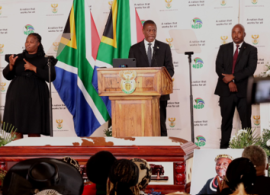
Deputy President Paul Mashatile has described His Majesty King Enock Makhosoke II Mabhena as a transformative monarch and a mighty tree who cared a lot about people.
“King Makhosoke II Mabhena was a transformative Monarch who prioritised education and health for the betterment of his people, guided by ancestral wisdom. His initiatives aimed to enhance the future of the Kingdom while ensuring the physical and spiritual wellbeing of those he led.
"Through various initiatives, he ensured that his people were not only enlightened and economically empowered but also active participants in preserving life, dignity, and communal harmony,” the Deputy President said on Sunday.
The Deputy President was delivering the eulogy at the Special Official Funeral service of the late His Majesty King Makhosonke II, King of the amaNdebele nation. The service was held at the Solomon Mahlangu Stadium in KwaMhlanga, Mpumalanga.
“A mighty tree has fallen, and its shade no longer shelters the amaNdebele people. Ascending the throne in 1986, His Majesty led with dignity and humility for four decades, preserving the sacred traditions that kept amaNdebele songs, murals, and rituals vibrant. He viewed heritage as a living force that shapes identity and strengthens community,” said Mashatile.
He added that the late King institutionalised the Komjekejeke to honour King Silamba, transforming it into a revered annual gathering, a symbol of resilience, unity, and cultural pride.
The King was also credited with advancing programmes that promoted men’s health and sustained the overall well-being of the communities.
“His Majesty's leadership was not confined to the boundaries of the AmaNdebele people. He understood that South Africa, in all its diverse ethnicities, is one nation. His voice did not echo only in the valleys of his people; it reverberated across the broader landscape of traditional leadership in our country.”
His legacy, he said, illustrated that Traditional Leadership transcends inheritance, serving as a bridge between ancestral memory and contemporary democracy.
The late King served as Chairperson of the Enkangala District House of Traditional Leaders, rose to Deputy Chairperson of the Mpumalanga Provincial House of Traditional Leaders, and was entrusted as a Member of the inaugural National House of Traditional Leaders, where he presided as Chairperson of the Traditions, Customs and Culture Committee.
His Majesty was also serving as Chairperson of the Majesties Forum, a sacred council of the recognised Kings and Queens of South Africa, where he worked to uphold unity, strengthen cooperation, and preserve the dignity and sanctity of traditional leadership.
The Deputy President recalled how the King played a significant role in strengthening the relationship between the Majesties and traditional leaders with government at all levels.
“He passionately, together with his fellow Majesties, coordinated development programmes and projects for the benefit of the traditional communities. One of his notable contributions in this regard was the preservation of the AmaNdebele Royal lineage, which kept the Kingship connected to its historical, customary, and ancestral roots,” he explained.
The late King also encouraged pride in language, customs, and royal institutions.
“He understood that a people who know their history stand taller in the present and walk more confidently into the future.”
Mashatile called on leaders to draw inspiration from the fact that His Majesty ruled not through fear or distance, but through counsel, listening, and example.
“Indeed, King Makhosoke II Mabhena exemplifies a rare leadership quality, contrasting with many contemporary leaders who prioritise personal gain over the welfare of vulnerable citizens.”
The Deputy President said South Africans must continue to build stronger communities, preserve cultural heritage, expand opportunities for youth, and ensure future generations inherit a more prosperous and united society.
“We should strengthen systems, uphold accountability, and resist the temptation to exploit power for personal advantage. We should embrace service as a sacred trust, ensuring that our authority is rooted in compassion and responsibility.”
Enhancing relations with traditional leaders
In addition, government is committed to honouring the King’s legacy by enhancing its relationship with traditional and Khoi-San Leaders.
“The government emphasises that traditional leaders will remain relevant and play a crucial role in governance, especially in rural areas. This commitment is backed by the Constitution, which affirms the importance of Traditional Leadership within South Africa's democratic system.”
To restore dignity and recognition, the government has implemented steps, including the establishment of platforms such as the National House of Traditional and Khoi-San Leaders, facilitating Traditional Leaders' involvement in policy-making on pressing issues such as land rights, socio-economic development, and infrastructure support.
In 2022, President Cyril Ramaphosa established the Inter-Ministerial Task Team to address these concerns, focusing on five key priorities: advancing land rights and socio-economic growth, enhancing traditional institutions, investing in infrastructure and skills, fostering nation-building, and finalising policy and legislative reforms. Government therefore remains committed to addressing the concerns of traditional leaders nationwide.
READ | Deputy President engages Traditional Leadership on mutual progress
In addition, a review of Traditional Leaders’ remuneration and benefits is underway at the national level, with the Independent Commission for the Remuneration of Public Office Bearers anticipated to submit its recommendations to the President shortly.
“This process aims to provide much-needed clarity and fairness in the support offered to traditional leaders,” said the Deputy President. -SAnews.gov.za


