


Government has intensified efforts to contain the spread of Foot-and-Mouth disease (FMD) through a nationwide vaccination campaign aimed at protecting livestock and supporting the country’s agricultural sector.
The Department of Agriculture has begun rolling out vaccines in affected and high-risk areas as part of a coordinated response to limit the spread of the highly contagious animal disease.
Foot-and-mouth disease affects cloven-hoofed animals such as cattle, sheep, goats and pigs. While the disease does not pose a direct threat to human health, outbreaks can have serious consequences for farmers, food security and trade in livestock and animal products.
Through the vaccination campaign, veterinary teams are working closely with farmers, provincial authorities and industry stakeholders to ensure that susceptible livestock are protected and that outbreaks are brought under control.
The vaccination drive forms part of a broader set of measures that include surveillance, movement control of animals and strengthened biosecurity practices on farms.
The intensified response follows government’s declaration of foot-and-mouth disease as a national state of disaster, which has enabled additional resources and coordinated interventions to be mobilised to contain the outbreaks.
With the vaccination drive continuing to make its way across the country, communal farmers have not been left out with Agriculture Minister John Steenhuisen and Gauteng MEC for Agriculture and Rural Development, Vuyiswa Ramokgopa, having recently spearheaded efforts to roll out the FMD vaccine campaign.
The Minister and MEC oversaw the rollout of the vaccine in Magagula Heights in the East Rand, Gauteng. Magagula Heights was the location of the first FMD outbreak in Gauteng in April 2025. South Africa is also advancing efforts to strengthen local vaccine development and production capacity to support the country’s long-term ability to prevent and manage animal disease outbreaks.
Patience has proven to be a virtue in South Africa’s journey to producing its first batch of the FMD vaccine in over two decades.
As the country moves towards becoming self - reliant in vaccine production and manufacturing, it aims to
start producing 20 000 doses a week by the end of March 2026, and then continue scaling up until it can to provide the nation with 200 000 thousand doses every week.
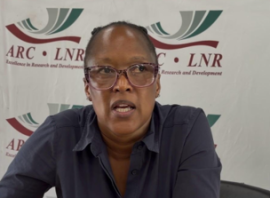
“Usually product development up until it goes to the market takes anything from 10, 20, some even to 30 years and there are also those that never make it to the market because they are not shown to be safe enough to be injected into animals,” Dr Faith Peta of the Agricultural Research Council (ARC) told SAnewsgov.za.
The council is an entity of the National Department of Agriculture, and Dr Peta is the ARC-OVR (Onderstepoort Veterinary Research) Chief Research Technician in the Vaccine Production Programme, which plays a crucial role in enabling the country to produce its own FMD vaccine for the first time since 2005.
Ageing technology and infrastructure, which were non-compliant with international Good Manufacturing Practice standards, led to South Africa ceasing production of the vaccine all those years ago.
However, in February 2026, Minister Steenhuisen visited the ARC-OVR facility to witness the finalisation of the first batch of the 12 900 locally produced FMD vaccines, signalling that the country had turned a corner.
Albeit small, the production of the first batch could not have come at a more opportune time, given the 14 million cattle that need to be inoculated in various parts around the country, as announced by President Cyril Ramaphosa in the State of the Nation Address. In the address, the President said this would require 28 million vaccines over the next 12 months.
Occurring in seven geo-specific serotypes, of which South Africa carries the Southern African territories serotype variant, foot - and - mouth disease causes lesions on the tongues of cattle and also affect their hooves and teats.
How the vaccine was made
As the vaccination campaign continues to gain traction, the process of developing the vaccine started with getting the right isolates, meaning the viruses that cause the disease in South Africa or Southern Africa. This involves researchers going into the field and collecting tissue samples, which are then brought back to the laboratory, where the main virus is isolated.
“A virus in nature unlike your bacteria and fungi, needs a living cell to grow in. They don’t just grow in the air or anything. What we do is we go to the lab and we first culture that material onto cells that have proven to be susceptible to the FMD virus. In our case we first use as primary cells, cells that are isolated directly from an animal. In that sense we use pig kidney cells. We infect the cells with the virus in a way of proliferating it [and] making more of the virus particle,” Dr Peta explained.
Once isolated, the cells are taken to “what we call continuous cell cultures in this case, baby hamster kidney cells.” After a certain amount of virus has been grown, its genetic makeup is studied and characterisation studies are conducted.
“When it meets a certain acceptance criteria, that indeed it is a Southern African territory virus and also can grow outside the body of an animal rapidly to a certain level, then we can make [the] vaccine. You need a lot of viruses to make a vaccine; you don’t need just one,” she said.
Prior to being infected with the virus, the cells need to be healthy.
“So you adapt your cells and it takes years. From the moment that we got the virus up to when we can grow it in cells in high volumes, it took us about five years or so. Then we needed to learn how to inactivate the virus. By inactivation, we mean killing the genetic material that makes it infectious. So, it’s still a complete virus but it loses its ability to cause the disease,” Dr Peta explained to SAnews, as we sat in one of the halls at the ARC campus in Onderstepoort, Pretoria.
The virus is then purified of unwanted biological material at which point it becomes a vaccine strain that grows “very nice in the laboratory”. It is then tested, starting off in small and then moving on to large animals to see whether it provides the desired effect. Following that, researchers go into the field to test away from the controlled parameters of the lab.
“Some aspects of that process are still going on as we speak. Currently we are testing its safety in pregnant animals,” she said.
The vaccine can also be used in sheep, goats and pigs as well, but “you also need to study how every animal reacts to it.”
The Department of Agriculture’s Foot and Mouth Disease Outbreak Report, dated 31 July 2025, noted that prior to January 2019, South Africa maintained a FMD-free zone without vaccination.
“In our country, we adopted the vaccination of cattle. The other animals are not vaccinated routinely; they are vaccinated in an event of outbreaks.”
She added that government has a disease control strategy which is characterised by separation of fences between wild and domestic animals. Given that buffalo are the natural hosts of FMD and that the FMD virus can transfer to cattle, cattle around the Kruger National Park (KNP) vicinity are traditionally vaccinated.
“The livestock around the Kruger National Park is vaccinated and if fences fail and there’s intermingling between the species, the domestic animals would not necessarily get sick. Animals around the KNP by law are not supposed to be taken out of the area that is demarcated, either by sale or anything. But now there has been a lapse in movement control, like we see with the illegal migration of people, there is the illegal migration of animals.”
In addition to making the vaccine non-infectious to animals, quality control and quality assurance also need to be done to ensure that the vaccine does not harm the animal.
“Hence, it takes this long to make a vaccine.”
She recalled the reluctance of people to take the COVID-19 vaccines, given the speed with which they were developed.
“People needed surety that they are not going to get harmed by these vaccines and concerns among others was whether the vaccine was tested to ensure it doesn’t harm them.”
With the country tackling FMD with the homegrown vaccine and imported vaccines from countries, including Argentina and Türkiye, the Chief Research Technician said staying focused was crucial in the development of the vaccine.
“You know that you have to be patient; that is the life of a researcher in general. You know it’s going to be a testing time for you to develop a product you can put on the shelves and yet, there is also that aspect that the country needs this, so you cannot afford to fail because it is of national importance.”
Longevity
The locally produced vaccine can last up to a year in the bodies of cattle.
“Our one has shown that immunity after vaccination can last up to 12 months. There are other ones whose immunity last for four to six months.”
Bio containment and skill
Dr Peta said the virus requires specialised facilities to make the vaccine hence the Onderstepoort campus has the ARC Veterinary Institute of Research, the University of Pretoria campus across the road, as well as the Onderstepoort Biological Products facility.
“FMD is quite specialised because not only does it require pharmaceutical standards to conform to it, but it also requires what we call bio containment working under negative pressure to atmospheric pressure. Our facility is the only one in South Africa allowed to work with Foot and Mouth, making those skills very rare. I don’t think we have a shortage of scientists in South Africa, but to translate the output to commercial [output] is still what’s lacking.”
To bridge this gap, in 2013 the ARC employed student scientists where it gave them experiential training in vaccine manufacturing of highly infectious viruses like FMD. These scientists have now studied up to Master of Science level and are pursuing various PhDs. These scientists will be specialised in the manufacturing of vaccines from infectious material.
She said South Africa invests a lot in scientists with several science councils given the existence of the Council for Scientific and Industrial Research (CSIR) and ARC for instance.
“The challenge at this stage is bridging the gap between scientific knowledge and application in the economy. The Department of Science, Technology and Innovation is looking into that through even the Tiers [of the South African Research Chairs Initiative that was set up to attract and retain excellence in research and innovation at public universities through research chairs established at Tier 1 and Tier 2].
“Since we as a country are an infrastructure restrictive country, there is lots of infrastructure required to make spinoffs of research output and it requires high capital,” she said.
New facility and scaling up production
The research council envisions building an FMD custom facility to the tune of R1.6 billion to help fight diseases like Foot and Mouth. In 2015, the ARC received approximately R500 million to construct the facility that would be able to contain the FMD virus.
“We had a budget shortfall to construct that. So, the facility has been designed and going through the final stages of approval of design. Once we break ground, we have planned to take up to 36 months to construct, and then an additional 12 months to validate [the facility]. So, we can say [that in] 48 months in total, we will be up and running.”
Processes in the old building will be transferred to the new facility.
“The aim of the country is to be self-reliant on vaccine manufacturing and stop the import of vaccines in the long run. Our aim is to start producing 20 000 doses per week at the end of March and then we will continue upscaling up until we are at a point next year where we will be able to provide the nation with 200 000 doses every week.”
The research council is also in the process of buying larger equipment to ensure that it can produce more vaccines.
“Twenty-eight million doses are required to handle the current outbreak, us providing 20 000 per month, is a drop in the ocean. Our aim is to scale up as we go. So 20 000 from now until the end of March next year and next year we go 200 000 because we are busy buying equipment of a larger scale. We are hoping that during this time, anytime from now, we will break ground and running parallel processes [with new] construction while we use the existing facility up to its maximum capacity which is the 20 000 doses per week.”
Recently, the Eastern Cape, which has an estimated cattle herd of 3.5 million had received 2 600 vaccine doses from the ARC in mid-February with other provinces like the Free State having having been allocated 2 300 doses and Gauteng having received 2 000 doses.
“The vaccine is out there and being used. The preliminary report from the field are quite encouraging,” she said.
Economic impact
In early February, it was reported that the Western Cape had recorded a first-ever FMD case in a dairy herd.
“Yes, they have picked up FMD, but the animals will be vaccinated; they will recover and the milk production might be lower, but it won’t be to a point where you don’t have milk on the shelf during the adaptation period,” she said.
She added that the highly contagious FMD has an economic impact on the country.
“The thing about FMD is it’s of economic impact, especially to people who export because once you have an FMD outbreak as a country, people, other countries stop importing animal products from you. In that regard, you lose market share. However, the slaughtering in the country will always be sufficient because the animal will recover, and it will enter the food chain and locally, because you’re not exporting, you will have full supply.”
Asked about whether she has concerns about the imported vaccines, Dr Peta said the processes of importing vaccines are clear and standard.
“No vaccine will get into the country without SAHPRA’s [South African Health Products Regulatory Authority] approval. In that regard, we are always assured and we do some of the testing of those vaccines as well. So we get the samples, test them and we recommend that you can bring them in, it will work in our setup or no this doesn’t seem to work.”
SAHPRA is an entity of the National Department of Health created by government to ensure the health and well-being of humans and animal health.
What to do if you suspect FMD in your cattle
Peta reminded the public that FMD does not affect humans in any way.
“It doesn’t make humans sick but however, humans can carry the FMD virus on their clothes. For example, if your neighbour has FMD and you don’t and you go there for a night cap you can bring Foot and Mouth to your own farm just by your clothes. It won’t make you sick in any way; it will just affect your animals. When your animals are infected, what you need to do is go to your district, your municipality office and ask for your local veterinary services.”
The veterinary services will then come and evaluate your farm and upon confirmation that the premises are infected, arrange for vaccines for your animals.
“The ARC does not sell vaccines over the counter to individuals as [FMD] is a state-controlled disease. For that reason, you notify your government first, then they are the ones that will come and get the vaccines and apply the vaccine in your farm. They will also advise you for a certain period not to move your animals until they say so. They will also take blood samples from your animals then bring it to our laboratories to test and then come back to advise you whether it is now safe for you to move your animals.”
Asked whether the vaccine is free, she said: “They will not charge you for the vaccine; the government heavily subsidises that.”
Dr Peta added that cattle are not only used for meat, but for ceremonial activities as well.
“I would advise that if your daughter is getting married and you are anticipating live cattle, be sure of their health status, don’t just accept animals because you could be bringing Foot and Mouth Disease into your kraal. Enquire first and ask for animal movement certificates and animal health certificates first. Just that beautiful gesture might cause you problems in your home.
“Let us familiarise ourselves with animal health matters and be aware that by just moving animals randomly even if you have a mgidi [celebration] of sorts, always be very careful of the health of animals you bring into your yard,” she cautioned.
None of us can imagine a country without cows mooing in the distance, therefore may the vaccination of the nation’s herd continue. After all, we are a country that loves our meat. -SAnews.gov.za


