


By Dikeledi Molobela
New York, USA — United Nations Secretary-General António Guterres has called for a more representative and interconnected global order grounded in international law, warning that widening geopolitical divisions, inequality, the climate crisis and rapid advances in artificial intelligence are manifestations of a broader struggle over power.
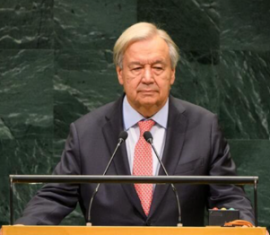
Opening the general debate of the 81st session of the United Nations General Assembly (UNGA81) in New York on Tuesday, Guterres said the world is undergoing profound shifts in how power is distributed and exercised.
“The fault lines in our world are widening. Cracks have become canyons,” Guterres told world leaders gathered at the UN headquarters.
He described conflicts, inequalities, climate shocks and technological disruption as interconnected challenges rather than separate crises.
“These are not separate crises. They are chapters of the same story. The story of power. Who has it; who is denied it; how it is used, and how it is changing?” he said.
Guterres identified three major shifts in global power.
The first is the emergence of new centres of economic, political and technological influence among States. The second is the transfer of power from governments to powerful private corporations and individuals, whose influence now extends across politics, economies, information and technology.
The third is the growing transfer of power from humans to machines, including through artificial intelligence and lethal autonomous weapons.
Guterres said these developments were taking place while global governance institutions continued to reflect power arrangements of a previous era.
“We are clearly moving towards a multipolar world, and that movement is irreversible.”
However, Guterres warned that multipolarity could either lead to greater fragmentation and rivalry or to what he termed “networked multipolarity”.
He described this as a world built on interdependence, with multiple centres of influence operating within a common framework of international law and shared rules.
Such an approach, he said, would recognise that no single power could address the challenges facing humanity alone.
“Building a networked future begins with a recognition, especially by superpowers, that their power isn’t so super,” Guterres said.
He stressed that military, economic and technological power each have limits and cannot, on their own, guarantee peace, stability or security.
Four tests of power
Guterres said the future will be shaped by how the international community responds to four major tests of power, war and peace, inequality, the climate crisis and artificial intelligence.
On peace and security, he highlighted conflicts in the Middle East, Ukraine, Sudan and Myanmar, warning that they demonstrated the consequences of power being exercised without sufficient restraint or accountability.
“These and so many other conflicts show what happens when power gets out of control, force outpaces diplomacy, military budgets soar, and accountability goes out the window,” he said.
Africa must have a sit at the UN Security Council
Guterres also renewed his call for reform of the UN Security Council to better reflect the contemporary international system.
He singled out Africa's continued lack of permanent representation on the Council.
“A 21st century Security Council without permanent African seats is unjust and indefensible. This must change,” he said.
Inequality
Turning to inequality, Guterres argued that disparities should not be viewed solely as an economic issue, but as a question of who has access to resources, opportunities and decision-making.
He called for reforms to the international financial architecture, including action on debt, stronger multilateral development banks and greater access to affordable long-term financing for developing countries.
Guterres also highlighted gender inequality, noting that the UN had achieved gender parity for the first time across its senior leadership, headquarters and professional staff.
“Equality is not a dream. It is a decision,” he said.
Climate action and AI
On the climate crisis, Guterres called on governments to adopt national plans to transition away from fossil fuels in line with the 1.5-degree goal, while ensuring protection for affected workers and communities.
He also called for greater climate finance and adaptation support for developing countries, arguing that those least responsible for climate change are often among those most affected by its consequences.
Turning to artificial intelligence, Guterres said the technology offered enormous opportunities, including advances in medicine and scientific discovery, but warned that its rapid development required stronger oversight.
“The danger is not technology. The danger is technology without accountability,” he said.
He called for greater international cooperation on AI safety, including dialogue, transparency, information-sharing, testing and common safeguards.
“Artificial intelligence must be shaped by humanity, with humanity, and for all humanity,” Guterres said.
He also warned against allowing machines to make life-and-death decisions.
‘Power requires rules’
Guterres said the four challenges are deeply interconnected and ultimately come back to the question of how power is exercised.
“Across all four tests, the decisive issue is power. The United Nations exists because power requires rules – and humanity needs a place where power answers to principle.”
He reaffirmed the UN Charter's three pillars of peace, development and human rights, arguing that they could not be treated as separate agendas.
“There is no peace without development; no development without peace, and no peace or development without human rights.”
Guterres also pointed to the Pact for the Future and the UN80 initiative as efforts to make the UN more responsive, effective, coherent and transparent, and more present where people need it.
“The world does not need a weaker United Nations. It needs a UN strong enough to face the world as it is – and determined enough to build the world as it should be,” he said.
The 81st General Debate is being held at UN headquarters in New York from 22 - 28 September under the theme: “Restoring trust, managing transformation: A United Nations that delivers for all”.
Guterres, who has 100 days remaining in his term, said he would continue defending the principles of the UN Charter.
“I will keep championing the conviction that peace is possible,” he said, adding that “the power of law must prevail over the law of power”.
He concluded by stressing that the international community's greatest responsibility is not to dominate, but to use power to build a future that benefits all.
“The greatest power is not the power to dominate. It is the power to build a future that works for everyone.
“Our shared future will be forged by whether humanity can govern power wisely,” he said. – SAnews.gov.za


