


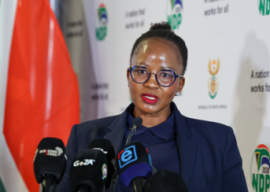
National Treasury says it does not expect the recently announced withholding of July 2026 equitable share transfers to 69 South African municipalities to impact service delivery.
High-ranking department officials briefed the media in Pretoria on Wednesday, following Tuesday’s announcement.
Deputy Director-General (DDG) for Intergovernmental Relations at the department, Ogalaletseng Gaarekwe, explained that portions of the share are released once municipalities submit signed payment plans with their creditors.
“This time last year, we had withheld for 75 [municipalities], but I can assure [you] that by early August, we had already released the money for everyone. So, it depends on how fast the municipalities sort out the payment plans and send us those payment plans.
“Once the portions are released, they pay [creditors]. Once they have done that, we release the whole amount. We are not expecting it to impact service delivery because… the majority of the funding at local government level is raised from own revenue,” Gaarekwe said at the briefing held in Pretoria.
The portion withheld amounts to some R13.5 billion from this year’s total R100 billion equity share.
The DDG was quick to emphasise that withholding funds is not punitive but corrective and also preventative, as non-compliance could lead to unintended real-world consequences.
“In our view, we are correcting the behaviour in municipalities. We need to get into the habit of paying our creditors. There are instances where pension fund monies are taken from salaries, but they are not paid over. So, if something happened… families are not able to claim because the municipality did not pay.
“We are trying to make sure that people do not get used to not paying,” Gaarekwe explained.
The affected municipalities were given notice ahead of the withholding of funds and were also encouraged to furnish reasons to the department why funds should not be withheld.
“The first set of letters were sent to municipalities on the 22nd of June and the 23rd. At that time, we wrote to 99 municipalities [and] 30 responded in a way that we have not withheld their money.
“This… is a last resort and we do not want to do it all the time. We are expecting that behaviour will change and we don’t have to do it again.
“We are really serious about compliance legislation so it’s important that municipalities…all three spheres of government comply with the legislation that we have,” Gaarekwe said.
Ripple effect
Chief Director of Local Government Budget Analysis at Treasury, Jan Hattingh, highlighted that continued non-payment by municipalities has a ripple effect that eventually leads to hamstrung service delivery.
“As a result of this action, jointly with the Department of Water and Sanitation, two water boards that were on the brink of being closed... are still operational. If a water board cannot proceed and provide services, the impact of that is much more negative, and that means communities cannot get water.
“There’s certainly a linkage [to the Auditor General South Africa’s 2024/25 Consolidated General Report on Local Government Audit Outcomes] but what we are trying to solve is when the Auditor General’s report is released, it’s after the event. What we have observed is that many councils adopt a budget that is not funded.
“So, part of our work and support… is to help them to table a funded budget and help them to deal with the planning problems upfront. If you don’t plan well and you overspend your budget, that portion is regarded as unauthorised expenditure,” Hattingh explained.
He added that the work National Treasury has been doing to guide municipalities has been “extensive”.
“We have even developed a framework for them to deal with consequence management. Ultimately, the councils make the final decisions, and therefore, they make the final choices.
“We are concerned that services are not rendered to communities. This is one of the issues that we are grappling with. [However], the real concern… is the fact that if municipalities don’t use grants productively and from time to time, the money gets surrendered back to the revenue fund.
“That is not the desired effect that we want because those services and that funding are meant to facilitate service delivery. Hence, we are working with provincial Treasuries and partners to equip municipalities to improve their planning [and] budgeting systems so that they can use this money properly, and citizens benefit from allocated resources,” Hattingh said. – SAnews.gov.za


