


South Africa is making measurable progress in advancing sustainable urbanisation, despite the dual challenge of expanding infrastructure to meet growing population demands, while maintaining ageing systems under financial strain.
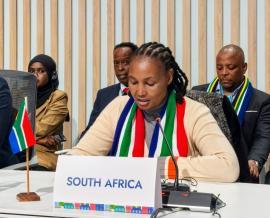
Human Settlements Minister Thembi Simelane made the remarks at the 13th session of the World Urban Forum (WUF13) under the Ministerial Meeting on the New Urban Agenda, that is underway in Baku in the Republic of Azerbaijan.
Held under the theme: “Housing the world: Safe and resilient cities and communities”, the meeting, taking place from 17 - 22 May 2026, places housing at the centre of discussions on inclusion, economic opportunity and climate resilience.
It brought together national governments, local leaders and international partners at a critical moment for cities.
Delivering the Country Statement on Sunday, 17 May 2026, Simelane said South Africa’s urban development trajectory reflects both significant gains and persistent structural challenges rooted in the country’s spatial legacy.
The country’s Integrated Urban Development Framework (IUDF), adopted in 2016 ahead of the global United Nations New Urban Agenda, serves as the government's primary macro-policy for managing urbanisation. The policy also includes provisions for spatial transformation aimed at addressing the historical injustices caused by the racial segregation in the country.
At the time the New Urban Agenda was adopted, South Africa was over 60% urbanised. Recent data indicates that this figure has grown to 68.82%, and it is projected to reach 71.3% by 2030. Urbanisation is undeniably an irreversible trend,” Simelane said.
Despite this growth, the Minister acknowledged that South African cities continue to face entrenched inequality, with many residents still living far from economic opportunities due to historic patterns of racial segregation.
Urbanisation has also intensified pressures on municipalities, contributing to challenges in basic services delivery, infrastructure backlogs, and overburdened municipal governance systems, which remain defining characteristics of South African cities.
Simelane noted that cities are increasingly required to balance expanding infrastructure networks with the maintenance and upgrading of existing assets, often under tight fiscal constraints and institutional limitations.
However, she said government has made steady progress, guided by the Constitution, the National Development Plan, and frameworks such as the District Development Model. These are aligned with continental and global commitments, including the African Union Agenda 2063 and regional development strategies.
The Minister also highlighted the broader global context impacting urban development, including the lingering effects of the COVID-19 pandemic, climate change, geopolitical tensions, and rising inequality and unemployment.
“These circumstances have significantly increased demand for essential services, including housing, health, education, water, and sanitation, while placing considerable pressure on public resources and the state's capacity to provide timely interventions to address these urban challenges,” the Minister said.
In response, she said government is reviewing key policy frameworks, including the IUDF implementation plan and the White Paper on Human Settlements, while also undertaking reforms to local government policy to strengthen service delivery and institutional capacity.
“A major priority is addressing informal settlements, particularly those located in high-risk or disaster-prone areas. Cabinet has mandated the department of Human Settlements to develop a strategy to address the construction of informal structures in dangerous, disaster-prone locations, including medium- to long- term solutions for Temporary Residential Units (TRUs). This includes accelerating the transformation of informal settlements and slums,” Simelane said.
Simelane said collaboration remains central to achieving sustainable urban transformation.
South Africa has hosted two National Urban Forum sessions in 2024 and 2025, bringing together stakeholders to accelerate progress towards the Sustainable Development Goals, particularly SDG 11 on sustainable cities.
These engagements have emphasised strengthening governance, improving access to development finance for municipalities, building technical skills, advancing climate resilience, and fostering partnerships with the private sector and communities.
The Minister also pointed to the growing importance of intermediate cities in South Africa’s urban system. These municipalities play a critical role in linking metropolitan areas with rural economies but often lack the institutional and financial capacity of larger cities.
She stressed that urbanisation must be actively governed through evidence-based planning, stronger coordination across all spheres of government, and meaningful community participation. – SAnews.gov.za


