


A young black woman in Roodepoort now manufactures soap for Boxer Super Stores. Another holds the title deed to a hotel in Mahikeng she could never have entered without transformation.
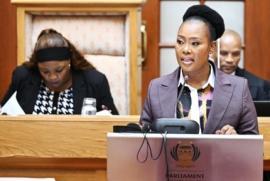
These are the faces behind the Department of Small Business Development’s (DSBD) R3.036 billion Budget Vote tabled in Parliament today, a budget the Minister Stella Ndabeni says is rewriting who owns South Africa’s economy.
Ndabeni anchored the allocation in the Constitutional guarantee of economic freedom and the lived reality of entrepreneurs the department serves.
“Budget Vote 36 gives practical expression to Section 22 of the Constitution which guarantees freedom of trade, occupation, and profession.
“It is about expanding opportunity, restoring dignity, and building an economy in which every South African – regardless of geography, gender, age, or social background – can add value and participate meaningfully.
“The National Development Plan [NDP] is clear that growth and jobs will come from small enterprises – just under 90% of new jobs and upward of 60% of new economic value. The evidence is clear: small enterprises are the largest employer in this economy. They are the entry point into economic participation for the majority of South Africans. They are where first-generation entrepreneurs build generational wealth. They are where transformation happens,” she said.
In this regard, the department has set a target of supporting at least one million Micro, Small and Medium Enterprises (MSMEs) and co-operatives over the tenure of the seventh administration.
“We are on track. During the past financial year we supported 288 123 MSMEs, with 117 134 enterprises receiving financial backing and 170 989 enterprises benefitting from non-financial intervention and development,” she said.
More than just numbers
Ndabeni told Parliament that although the Budget Vote speaks to the department’s plans and achievements, “behind each of these numbers is a South African entrepreneur”.
She told the story of businesswoman Mahapa Raisibe Matlhako who runs a wholly black, youth and woman-owned manufacturing company in Roodepoort, Gauteng.
With the department’s support, Matlhako is now a private label manufacturer for Boxer Super Stores producing three types of soap.
“But fulfilling a contract at national retail scale requires capital that a young Black woman manufacturer, however talented, could not access. SEDFA [Small Enterprise Development and Finance Agency] stepped in through its Small Enterprise Manufacturing Support Programme, providing R13.8 million. This created 32 new jobs.
“That is not just enterprise development. That is supply chain transformation. And this is what a young woman in Roodepoort is delivering – with SEDFA behind her,” Ndabeni said.
Another beneficiary of the department’s work is Thenjiwe Tsabedze, a black woman who acquired the Protea Hotel in Mahikeng and renamed it Indalo.
She was also backed by SEDFA and other financial institutions to the tune of some R80 million.
“This is not a small moment. A Black woman now holds the title deed to a property that, under a different political order, she could never have entered through the front door. Now she signs the contracts. Now she sets the vision. Now she employs the staff and shapes the guest experience,” Ndabeni told the House.
Building rural economies
The minister highlighted that the department’s budget will also prioritise building the township and rural enterprise.
Ndabeni added that the department has now developed the Township and Rural Economic Development and Revitalisation Policy.
“We will also be scaling our offerings as the DSBD portfolio for township and rural enterprises, building on the successes of 2025/26 where we disbursed more than R829 million to over 111 000 MSMEs through the Township and Rural Entrepreneurship Programme.
“The funding limit of TREP has now been increased from R1 million to R3 million to broaden access and deepen impact. This year we have allocated R710 million,” she said.
The grant-based Asset Assist Programme supported at least 938 MSMEs to the value of R190 million.
A further R215 million has been allocated to “provide a minimum of 860 MSMEs with productive assets that enhance their capacity, productivity, and competitiveness”.
“Our Spaza Shop Support Fund, which we implement together with the DTIC, supports spaza shops with stock acquisition, formalisation, compliance, and operational sustainability. To date 1316 have been approved for funding through the fund to the value of R79.6 million,” she said.
The allocation
The department’s budget for the 2026/27 financial year amounting to R3.036 billion will be allocated as follows:
- R2.154 billion is allocated to transfers and subsidies.
- R277.1 million is allocated to compensation of employees.
- R597.2 million is allocated to goods and services; and
- R7.8 million is allocated to capital expenditure.
SEDFA will receive some R1.899 billion of the transfers and subsidies allocation.
“This Budget Vote reflects our commitment to measurable impact, ensuring that public resources translate into more supported businesses, more jobs created, and a transformed economy with higher levels of inclusion,” Ndabeni concluded. – SAnews.gov.za


