


Human Settlements Minister Thembi Simelane says stronger collaboration between government, communities, the private sector, civil society and other stakeholders is key to tackling the country’s urban challenges and accelerating the creation of adequate, inclusive and sustainable human settlements.
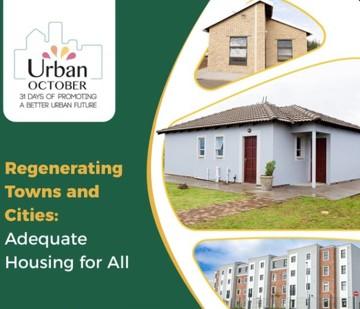
Simelane made the call as South Africa joins the international community in commemorating World Habitat Day on Monday and launches its Human Settlements Month and Urban October campaigns under the theme: “Adequate Housing for All”.
The theme comes amid a global housing crisis, with an estimated 2.8 billion people experiencing various forms of housing inadequacy, while nearly 1.1 billion people live in slums and informal settlements.
These challenges are being compounded by conflict, disasters and climate change, with people in vulnerable situations often facing the greatest risks and having the fewest resources to recover.
Simelane said the situation highlighted the need for urgent, coordinated and sustained action to ensure that adequate housing becomes accessible to all.
She said South Africa’s response to rapid urbanisation must go beyond policy development and focus on implementation, partnerships and meaningful participation across society.
“Our experience over three decades of democracy has taught us that stakeholder consultation is critical to the formulation of effective public policy. However, going forward, stakeholders must be fully engaged beyond policymaking by creating spaces and opportunities for them to contribute to public investments and to actively implement the policies we have collectively agreed upon,” Simelane said.
Simelane’s call is aligned with South Africa’s commitments under the New Urban Agenda (NUA), a global framework adopted in 2016 to guide sustainable urban development to 2036.
South Africa remains a partner of UN-Habitat, with the Ministry and Department of Human Settlements playing a leading role in advancing the country’s engagement on the global urban agenda.
As part of these efforts, Simelane presented South Africa’s Second Country Report on the implementation of the New Urban Agenda. The report reflects stakeholder consultations involving the three spheres of government and various sectors of society across the country.
South Africa’s commitment to the global urban agenda has also been strengthened through the establishment of the UN-Habitat Country Office and Country Programme in South Africa, under a joint framework between the South African Government and UN-Habitat.
The partnership will support national priorities, including spatial transformation, urban development, housing, integrated human settlements, climate resilience, urban finance and local government.
It will also strengthen technical assistance and partnerships aligned with the National Development Plan, Integrated Urban Development Framework, District Development Model, New Urban Agenda and the 2024–2029 Medium-Term Development Plan.
As part of Human Settlements Month, Simelane said the department will lead a programme of engagements involving communities, cities, municipalities, civil society, the private sector and other stakeholders.
“The transformation of our cities, towns and communities cannot be achieved by government alone. It requires partnerships, active citizenship, and a shared commitment to ensuring that our people live in safe, adequate, and sustainable human settlements,” she said.
Simelane also called on stakeholders to use Urban October as an opportunity to deepen dialogue on the future of South Africa’s urban areas and contribute to practical solutions to the challenges associated with rapid urbanisation.
Through Human Settlements Month and Urban October, South Africa will participate in the global conversation while showcasing programmes, projects and partnerships aimed at accelerating the delivery of sustainable human settlements. – SAnews.gov.za


