


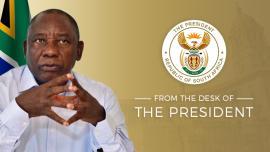
The South African government will pursue its commitment to fiscal discipline and reform implementation as the upcoming South African Investment Conference (SAIC) provides a pivotal moment to translate recent economic gains into tangible investment outcomes.
This according President Cyril Ramaposa’s weekly newsletter, released ahead of the conference, to be held at the Sandton Convention Centre on Tuesday.
The gathering is South Africa’s premier and high-level platform to mobilise investment, showcase opportunities and to translate investments into tangible outcomes such as employment.
This year, more than 1 000 delegates will attend the SAIC, representing some 50 different countries.
“This year’s investment conference stands at the crossroads of opportunity and ambition.
“The clear message we will be delivering is that we remain committed to staying the course on fiscal discipline, to accelerating the momentum of the reform agenda – and to leveraging investment to build an economy that is inclusive, transformed and that benefits all,” President Ramaphosa said.
The President laid out the case for South Africa as an investment destination of choice in the face of “increasingly volatile global financial conditions”.
“We are Africa’s largest economy with a diversified industrial base. Since we began our first R1.2 trillion investment mobilisation drive in 2018, we have secured investment pledges in mining, healthcare, automotive, food and beverage and others, reflecting the sophistication of our economy.
“South Africa is also the leading destination for renewable energy investment on the continent, with these investments making up a considerable share of the total pledges made at previous conferences.
“We have a sound policy and regulatory environment, offering certainty to investors at a time when we are just one of many emerging markets across the globe vying for capital,” he said.
A growing economy
President Ramaphosa said that the 2026 SAIC, as well as those preceding it, is aimed at building “even greater confidence in our country as an investment destination” as well as demonstrating government’s commitment to reforms, policy certainty and execution.
He added that the “green shoots of economic recovery we are experiencing” further bolster South Africa’s position.
“The macroeconomic outlook has improved. We experienced four consecutive quarters of growth by the end of 2025, national debt has stabilised and more jobs are being created. Last year, our sovereign rating was upgraded for the first time in 17 years, and we were removed from the Financial Action Task Force grey list.
“The structural reform agenda being driven through Operation Vulindlela has unlocked progress in electricity, freight logistics, water, telecommunications, and the visa system.
“We have brought load-shedding to an end and are creating a new, competitive electricity market that will ensure energy security and attract investment,” he highlighted.
The logistics sector is also undergoing modernisation and private investment in port and rail operations is also being enabled.
“Among the projects for which we have initiated a Private Sector Participation [PSP] process are the Ngqura Manganese Export Corridor in the Eastern Cape and the Richards Bay Dry Bulk Terminal in KwaZulu-Natal.
“Last year, we also signed a 25-year concession for the Durban Container Terminal Pier 2, representing R11 billion in private investment. A system for third-party access to the freight rail network is in place and 41 freight rail slots have been allocated to private companies,” President Ramaphosa said.
Additionally, reforms to the visa regime have also been implemented to attract skills and promote tourism.
“These include operationalising the Remote Work Visa, introducing a Trusted Employer Scheme to support major investors, and piloting an Electronic Travel Authorisation system.
“By showcasing the progress and durability of the reform agenda, our goal is to grow the pool of inward investment from businesses and countries that will ultimately be a bridge to new markets, technologies and networks for South Africa,” he said.
From pledges to projects
The first five-year investment mobilisation of the SAIC exceeded its target of R1.2 trillion in commitments – reaching some R1.57 trillion.
Some 300 projects were initiated and to date, 161 of these are now either finalised or still under construction.
“The pledges have not been merely vague commitments and promises, but have materialised as tangible, brick-and-mortar projects that are creating jobs for our people.
“Last year, I opened the Platreef Mine in Mokopane in Limpopo, that is positioned to play a leading role in the production of sought-after critical minerals for the energy transition. This facility that employs more than 2 000 workers from the local community and is partly owned by a community trust, emanated from a R2,8 billion investment pledge by Ivanhoe Mines at the South Africa Investment Conference in 2022.
“Last year, I also visited the BMW plant in Rosslyn in Tshwane, where the automotive giant has invested R4,2 billion for electrification of its only plant on the continent that will be producing the BMW X3 Plug-in Hybrid electric vehicle. This was also an investment pledged at the SAIC,” President Ramaphosa highlighted.
As South Africa puts on the final preparatory touches ahead of the conference on Tuesday, the administration is placing its emphasis on execution over announcements.
“By showcasing our unique and favourable proposition as an investment destination of choice, we have set ourselves the goal of mobilising R2 trillion in new investments by 2028.
“As we strive to achieve growth that creates jobs for our people, this next phase will move from pledges towards implementation,” President Ramaphosa said. – SAnews.gov.za


