


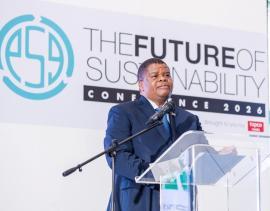
Water and Sanitation Deputy Minister David Mahlobo has emphasised the critical role of partnerships in addressing South Africa’s water and sanitation challenges.
Mahlobo was speaking at the 2026 Future of Sustainability Conference, held in Johannesburg, on Wednesday.
Held under the theme: “Africa’s Green Horizon: Leading the Global Transition,” the two-day conference brought together sustainability leaders, policymakers, business executives, academics, and industry specialists to address pressing environmental challenges and explore innovative, sustainable business strategies.
Established in 2011 through a partnership between Topco Media and the United Nations for the COP17 climate conference, the conference has evolved into a key platform for exploring pioneering solutions for a sustainable future.
Mahlobo said collaboration between government and the private sector is essential to resolving water supply challenges.
“There is no single institution, municipality, department, company or country that can solve the water challenge alone,” he said.
He warned that ageing infrastructure and outdated technology, combined with population growth, have led to the current water supply challenges experienced in most parts of the country.
“The water challenges confronting South Africa are well known, but their seriousness demands that we name them plainly and confront them honestly.”
He warned that ageing infrastructure and outdated technology, combined with population growth, have exacerbated water shortages across the country.
He cited key issues, including infrastructure deficits, climate variability, rapid urbanisation, the pollution of rivers, and operational weaknesses in some wastewater systems, as well as persistent inequality in access to water, particularly in rural and historically marginalised communities.
Addressing these challenges he said, demands a coalition of capability at local, national, and global levels.
“Water security requires alignment across government departments, water boards, municipalities, regulators, state entities, research institutions, financiers and the private sector. We must end the old culture of silo governance.
“The era of fragmented mandates, parallel planning without integrated execution, and infrastructure built without adequate maintenance discipline must come to an end,” Mahlobo said.
He also highlighted the importance of data-driven decision-making and technology.
“What gets measured gets managed, and what gets managed well gets sustained,” he said, adding that technology is essential for improving accountability and efficiency.
The Deputy Minister further advocated for the diversifying approach to water supply through groundwater development, wastewater reuse and integrated urban water systems to reduce pressure on traditional sources.
Referring to the United Nation’s declaration of 2026 as the Water Year, Mahlobo reaffirmed government’s commitment to ensuring access to water as a constitutional right.
He urged South Africans to change water habits and adopt a water saving approach to ensure a more sustainable use of water for everyone.
“Communities are not passive beneficiaries… they are co-creators of resilience. When communities are organised, informed and included, they become a force multiplier for sustainability.
“They help protect infrastructure, strengthen accountability, support behavioural change, defend local ecosystems, detect failures earlier and give legitimacy to interventions that might otherwise remain abstract,” Mahlobo said.
In concluding his address, Mahlobo called for urgent action to build a better world for future generations.
“We have less than four years to achieve Sustainable Development Goal (SDG) 6, and we are not on track. In your hands lies the duty to create a better world. We will not be doing it for our sake; we are holding it for our children.”. – SAnews.gov.za


