


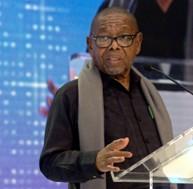
Science, Technology and Innovation Minister, Professor Blade Nzimande, has flagged the continued concentration of public research funding at South Africa’s leading universities, saying institutional inequality limits the country’s ability to draw on talent across the entire higher education system.
Speaking at the 2026 National Research Foundation (NRF) Awards in Gqeberha on Thursday, Nzimande disclosed that about 63% of NRF funding goes to the 10 universities producing the most research, while 83% of South African Research Chairs Initiative (SARChI) chairs are hosted by top-output universities.
The ceremony, held under the theme: “Building an Inclusive, Impactful and Transformed Research Future”, recognised researchers whose work had advanced science for society’s benefit.
The Minister will on Friday conclude his two-day programme in the Eastern Cape with a visit to the Coega Special Economic Zone (SEZ). At the SEZ, discussions will be held to examine the proposed establishment of a Science and Innovation Park intended to strengthen the province’s innovation ecosystem and support emerging industries, including energy security and green hydrogen.
“This issue is crucial not for posterity, but for practical reasons – to ensure our country, with its scarce resource base, makes full use of its institutional resources to reach deeper and wider into every corner of South Africa and unleash its full potential,” he said.
Nzimande acknowledged that the best-performing universities continued to receive the largest share of NRF support, but said interventions were being implemented to address inequalities inherited from apartheid-era higher education.
“To broaden participation, strengthen capacity, and deepen structural transformation, earlier this year we awarded 41 new SARChI chairs, specifically for historically disadvantaged institutions, universities of technology and new universities,” he said.
The NRF had also begun implementing its University Programmes and Collaborations initiative, comprising tailored interventions intended to improve research and human-capital capacity at historically disadvantaged institutions.
Nzimande nevertheless pointed to substantial demographic changes in the researchers and postgraduate students supported by the NRF. In 2025, the proportion of Black South African NRF-funded students increased to 86%, a sharp rise from 46% in 1999. During this period, the proportion of South African women postgraduate bursary recipients rose from 40% to 60%.
In the 2025/2026 financial year, the foundation awarded bursaries to 5 951 postgraduate students, with 77% receiving full-cost-of-study support. Among funded researchers, Black representation increased from 15% in 1999 to 57% in 2025, while women’s representation rose from 17% to 47%.
“If science, technology and innovation is to serve society, then the people who produce knowledge, the institutions that host research and the students who enter the research pipeline must reflect the full diversity and potential of the whole of our country,” the Minister said.
However, he warned that slower growth in public investment, particularly since the COVID-19 pandemic, had constrained the number of financially disadvantaged students benefiting from the full-cost funding model introduced in 2020.
He also called for stronger efforts to convert publicly supported research into commercially viable products.
“South Africa pays far more for foreign intellectual property than it generates from its own innovations. We must bridge the gap between academic research and commercial application by, among others, co-funding early-stage tech development with private industry, driving venture capital into local start-ups and turning indigenous discoveries into market-ready products,” Minister Nzimande added.
He argued that technological capacity had become increasingly important as geopolitical rivalries centred on semiconductors, algorithms, energy, telecommunications and defence systems.
“This has increased urgency for governments in the Global South to cultivate domestic technological capabilities to reduce critical dependencies on foreign adversaries for energy, telecommunications, and defence systems,” he said.
Nzimande also urged the continent to build a “sovereign research and development agenda for Africa” that was “designed, funded and executed by Africa”.
“For too long, Africa’s research priorities have been dictated by external donor funding rather than continental needs. Initiatives such as the Science Granting Councils Initiative will be critical in this regard,” he said. – SAnews.gov.za


