


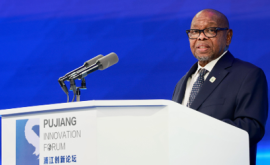
Shanghai, China- South Africa has called for countries of the Global South to become producers and owners of emerging technologies as it moves to deepen scientific cooperation with China.
Science, Technology and Innovation Minister Professor Blade Nzimande said rapidly advancing fields such as artificial intelligence (AI), quantum technologies, biotechnology and space science, advanced materials and clean technologies were reshaping economies and national development.
Addressing the 19th Pujiang Innovation Forum in Shanghai, China, on Saturday, Nzimande warned that these changes were unfolding amid geopolitical and economic instability.
“This is also a moment of profound geopolitical and economic uncertainty, where science, technology and innovation are being increasingly weaponised by certain nation-states,” the Minister said.
“For this reason, we believe that the Global South cannot afford to stand on the margins of this new era. We must be co-creators of knowledge, co-designers of technology and co-owners of the industries that will define the future.”
South Africa, the first African nation designated Country of Honour at the forum, intends to use the platform to advance the continent’s science, technology and innovation agenda under the African Union’s Science, Technology and Innovation Strategy for Africa 2034.
Nzimande said South Africa and China would pursue closer collaboration in “artificial intelligence, joint research centres, space science and astronomy, quantum computing, cybersecurity, public engagement, youth development and the Young Scientists Exchange Programme”.
Cooperation between the two countries is governed by a science and technology agreement signed in 1999, during former President Nelson Mandela’s administration. It has since expanded into health, traditional medicine, astronomy, forestry, palaeontology and energy research.
“Our cooperation with the People’s Republic of China remains a critical component of our bilateral relationship,” Nzimande said, adding that the partnership was rooted in “solidarity, development cooperation and multilateral engagement”.
He cited South Africa’s MeerKAT telescope and the Square Kilometre Array as evidence that Africa could “host, design and operate mega-science infrastructure of global significance”.
Through cooperation between the South African National Space Agency and its Chinese counterpart, the countries were also strengthening earth observation, disaster management, ocean monitoring and data systems supporting climate resilience and human security.
Nzimande said scientific partnerships must deliver measurable opportunities rather than remain diplomatic undertakings.
“Our universities, research councils and innovation agencies must translate the opportunities of Pujiang into joint laboratories, research programmes, skills pipelines and commercial partnerships,” he said.
He highlighted the Young Scientists Exchange Programme, through which fellowships, laboratory placements and mentorship had exposed young researchers to advanced industrial research environments.
The Minister also called for stronger pathways between scientific discovery and commercial production, saying South African inventions frequently struggled to progress from prototypes to scaled enterprises because finance, markets and industrial demand were insufficiently connected.
“For too many innovators, the hardest journey is not from ignorance to discovery, but from discovery to market,” he said.
Platforms such as InnoMatch could connect South African clean-tech, fintech and biomedical start-ups with investors, multinational companies and buyers seeking innovation.
Nzimande said the country’s vaccine manufacturing ambitions and participation in the World Health Organisation’s mRNA technology-transfer hub reflected a key lesson from the COVID-19 pandemic: “Africa must never again stand at the back of the queue for life-saving technologies.”
The Minister also praised China for hosting the International Open Science Conference on Friday, saying open science could make knowledge, data, methods, software and infrastructure more accessible, transparent and inclusive. South Africa champions the movement alongside China, Brazil and the African Union.
READ | Make scientific data more accessible for developing countries, DSTI urges
He said South Africa stood ready to work with China and other partners to create a future “in which innovation is shared, technology is used responsibly, and science becomes a bridge between nations, peoples and generations”. -SAnews.gov.za


