


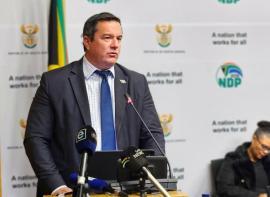
Minister of Agriculture John Steenhuisen has approved a new set of national Foot and Mouth Disease (FMD) control measures aimed at providing livestock farmers with a clearer path to recovery during outbreaks while safeguarding South Africa’s agricultural trade and biosecurity.
The measures, which will take effect once published in the Government Gazette, consolidate and replace a range of previous directives, including the 2019 FMD Contingency Plan and subsequent amendments.
The new framework creates a single, integrated national system for managing FMD outbreaks from detection through to recovery.
Announcing the changes on Thursday, Steenhuisen said livestock producers require certainty and practical solutions to manage disease outbreaks without unnecessarily threatening their livelihoods.
“South Africa’s livestock producers need clear rules, sound science and practical pathways that allow them to manage outbreaks without unnecessarily jeopardising their livelihoods,” he said.
Foot and Mouth Disease remains one of the most economically damaging animal diseases affecting the livestock sector, with outbreaks capable of disrupting production, limiting market access and placing severe financial pressure on farmers and rural communities.
A key feature of the new measures is the introduction of risk-based pathways that allow certain trade activities to resume during quarantine periods.
Animals may be sent to designated FMD abattoirs from 16 days after a property has been declared clinically clear, while broader slaughter options, including export-approved facilities, become available after 42 days.
The revised framework also clarifies that vaccinated animals that have never been infected and are not under quarantine remain healthy and may continue to be traded and moved under normal regulations.
Steenhuisen said the objective was to balance disease control with economic sustainability.
“The objective is simple: protect animal health and stop the disease spreading, while ensuring that farmers can continue operating safely wherever possible,” he said.
The measures further reduce unnecessary destruction of animal products and agricultural inputs.
Based on updated scientific understanding of the FMD virus, products such as feed, fodder and manure will now be managed according to scientifically established risk periods rather than blanket disposal requirements.
Another major reform is the introduction of alternative recovery pathways for affected farms.
Producers will no longer automatically be required to remove entire herds before quarantine restrictions can be lifted. Instead, they will be able to choose from several options, including restocking with vaccinated animals or sourcing livestock from FMD-free areas.
“For many farmers, particularly those operating under difficult financial conditions, the prospect of losing an entire herd can be devastating. These measures introduce practical alternatives that are scientifically sound and economically realistic,” Steenhuisen said.
The framework also introduces, for the first time, dedicated provisions for communal and peri-urban livestock systems.
The measures recognise the unique challenges associated with shared grazing areas, multiple ownership structures and different livestock movement patterns, providing tailored quarantine and vaccination approaches.
In addition, well-fenced farms will be able to manage outbreaks within affected sections of a property rather than placing entire operations under full quarantine.
Veterinary procedures have also been streamlined, and farmers seeking authorisation to move products will benefit from clearer response timelines and escalation mechanisms.
The measures were developed through extensive consultation with the Department of Agriculture, the Ministerial Task Team, the FMD Industry Coordination Council and veterinary experts.
Steenhuisen described the new framework as a significant step in strengthening South Africa’s biosecurity system while supporting the long-term sustainability of the livestock industry.
“These measures reflect the latest scientific evidence, recognise the realities facing farmers on the ground and provide a balanced framework that protects animal health while limiting economic disruption,” he said.
The Department of Agriculture will continue monitoring the effectiveness of the measures and has committed to conducting a formal review within 12 months of implementation. – SAnews.gov.za


