


South Africa and Zimbabwe must move beyond their strong historical and political ties and translate their bilateral relationship into tangible economic opportunities, including investment, trade, jobs, infrastructure and improved livelihoods.
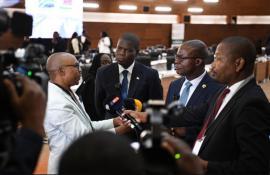
This was a message delivered by International Relations and Cooperation Minister Ronald Lamola, on Thursday, at the opening of the Ministerial Meeting segment of the Fourth Session of the South Africa–Zimbabwe Bi-National Commission (BNC) in Pretoria.
The Minister said the two countries had a strong foundation for deeper cooperation, anchored in their shared history and geographical proximity, but stressed that the success of the BNC would ultimately be measured by its impact on the lives of ordinary people.
“Our political relationship is strong. Our historical bonds are deep. Our geographical proximity creates enormous opportunities. What is required now is to convert these advantages into concrete programmes and projects that improve the lives of our peoples,” Lamola said.
He called on Ministers and senior officials from both countries to identify areas where progress could be accelerated and to address obstacles that have delayed the implementation of bilateral commitments.
“Let us ensure that the decisions we take here are supported by clear responsibilities and realistic timelines. The true measure of the success of this Bi-National Commission will be the extent to which our decisions translate into investment, trade, jobs, infrastructure, energy security, food security and improved livelihoods for our peoples,” he said.
The BNC, established in April 2015, serves as the central mechanism for managing and advancing the strategic partnership between South Africa and Zimbabwe.
More than 33 agreements and memoranda of understanding have been concluded between the two countries across various areas of cooperation.
Unlocking economic potential
Lamola identified infrastructure connectivity, energy, agriculture, critical minerals and private-sector investment as key areas where the two countries can deepen cooperation and unlock economic opportunities.
He said South Africa and Zimbabwe are integral partners in the North-South Corridor, with the Beitbridge Border Post serving as a major gateway for the movement of people and goods between the two countries and the wider region.
“We should use this shared geographical and economic advantage to deepen cooperation along the corridor, including through the modernisation and expansion of road and rail infrastructure, the improvement of border management systems, the development of logistics facilities and the strengthening of connectivity with ports and regional markets,” Lamola said.
He also called for stronger cooperation in water security and digital connectivity, saying infrastructure cooperation should extend beyond transport to support communities, agriculture, industry, trade and investment.
The Minister highlighted the agricultural relationship between the two countries, noting that South Africa was Zimbabwe’s second-largest agricultural export market in 2025, with exports valued at approximately US$202 million.
Zimbabwe, meanwhile, was South Africa’s second-largest agricultural export market globally and its largest on the African continent, with exports valued at approximately US$1.1 billion.
Lamola said the two countries should expand their cooperation beyond trade in finished products to include seeds, machinery, agricultural technologies and agro-processing.
“This should form part of a broader effort to develop regional value chains. Our two countries should work together to ensure that the minerals, agricultural products and other resources produced in our region generate greater value within Southern Africa,” he said.
He also urged the countries to pursue greater beneficiation and value addition in the minerals sector, particularly as both are endowed with critical minerals that are increasingly important to the global economy.
Migration and energy cooperation
The Minister also placed migration high on the bilateral agenda, describing the Zimbabwe–South Africa route as one of Africa’s busiest migration corridors.
He said Zimbabwe is the largest country of origin for migrants to South Africa, accounting for approximately 48 percent of the migrant population.
Lamola said the two countries needed to strengthen cooperation on migration management, border governance and the facilitation of lawful movement.
“Safe, orderly and regular migration benefits South Africa, Zimbabwe and the wider region. Together, we must continue to cooperate on migration management, border governance and the facilitation of lawful movement,” he said.
He welcomed the Southern African Development Community’s call for a migration dialogue aimed at addressing the underlying drivers of migration and developing sustainable regional responses.
Energy security was also identified as an important area for closer cooperation, with Lamola calling for collaboration in electricity generation, transmission and regional power connectivity through the Southern African Power Pool.
He said this should include investment in new generation capacity, renewable energy and technologies capable of strengthening the resilience of both countries’ energy systems.
From bilateral ties to regional integration
Lamola said South Africa and Zimbabwe should ensure that their bilateral cooperation contributes to wider regional integration and the implementation of the African Continental Free Trade Area.
He called for joint initiatives that support SADC priorities, particularly infrastructure development, industrialisation, energy security, food security and regional value chains.
The Ministerial segment will feed into the Heads of State meeting on Friday, when President Cyril Ramaphosa will host Zimbabwean President Emmerson Mnangagwa for the Fourth Session of the South Africa–Zimbabwe BNC in Pretoria. – SAnews.gov.za


